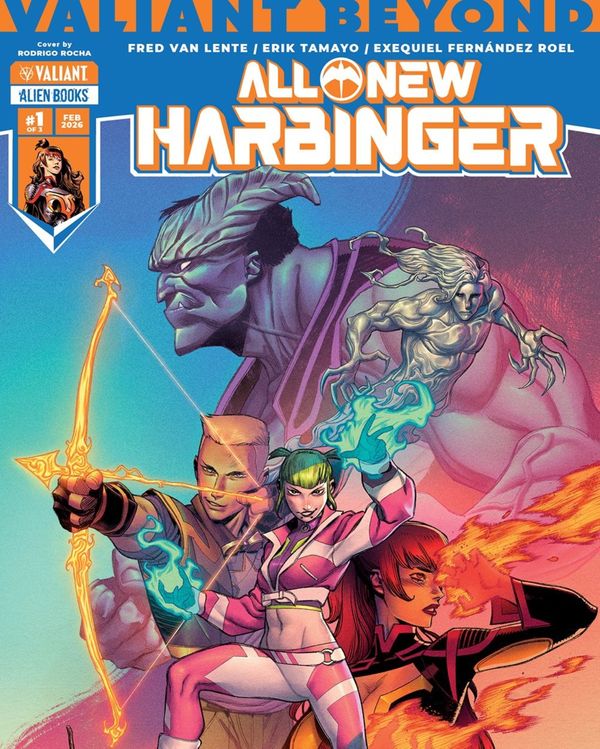
Valiant Beyond: All-New Harbinger #4, by Alien Books & Valiant Comics on 2/4/26, places the series’ moral center on trial: team leader Archer discovers that the beloved Supremum Stanchek may have committed mass murder for political gain.
Credits:
- Writer: Fred Van Lente
- Artist: Erik Tamayo
- Colorist: Exequiel F. Roel, Ludwig Olimba
- Letterer: Camila Jorge
- Cover Artist: Rodrigo Rocha (cover A)
- Publisher: Alien Books, Valiant Comics
- Release Date: February 4, 2026
- Comic Rating: Teen
- Cover Price: $4.99
- Page Count: 28
- Format: Single Issue
Covers:

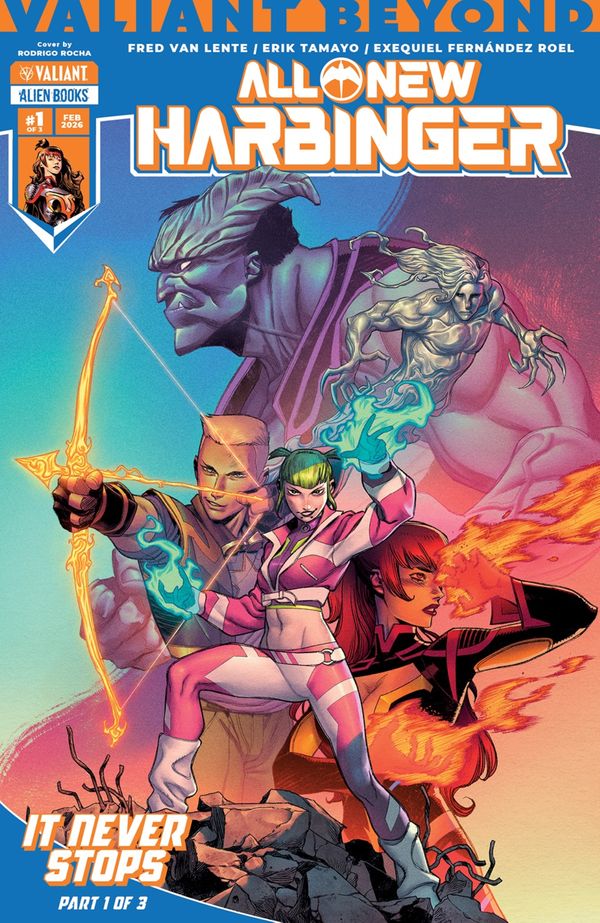
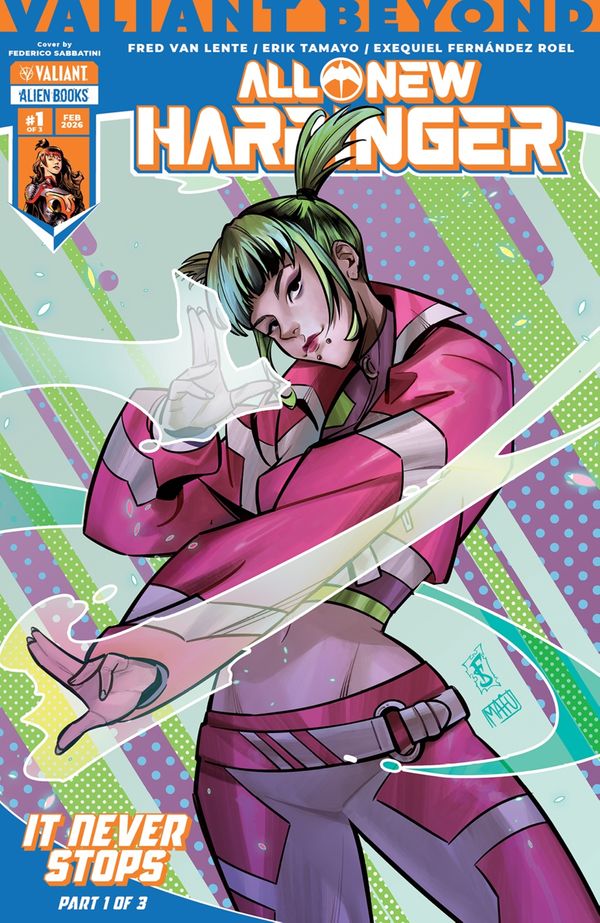
Analysis of VALIANT BEYOND: ALL-NEW HARBINGER #4:
First Impressions:
I came away from this one conflicted, which is honestly the right kind of discomfort to feel. The comic swings for genuine narrative stakes by placing Archer in an impossible position: protect a mentor figure he loves or confront an ugly truth that could unravel his entire world. That tension alone hooks you. The pacing, however, stumbles under the weight of world-building exposition and tonal whiplash, bouncing from intimate character moments to sprawling prison sequences without enough breathing room to land any of them with real impact.
Recap:
In Valiant Beyond: All-New Harbinger #3, Supremum Stanchek opened the issue with a sermon about power and obligation, speaking to an anxious crowd and peppering the narrative with the message, “To whom much has been given, much more will be required,” a mantra that echoed throughout the chaotic events of Foundation City. Outside the city’s protective dome, tempers and powers flared as Steppers argued about methods for tunneling in, setting the stage for Flamingo’s fiery display and underscoring the motif of exclusion and resentment. Soon, chaos ramped up inside the dome as Alloy tried to extract the trigger device from a terrorist’s explosive bomb, while Livewire was pressured to halt mech-forms designed to resist her technopathic attacks. With team dynamics strained and everyone under fire, Chung-Cha Kwan vied for acceptance and respect, having a tense exchange with team leader Prodigal that highlighted her motivation, the scars of personal tragedy, and the tricky dance of authority and insecurity.
Plot Analysis (SPOILERS):
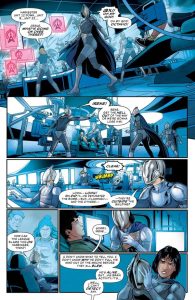
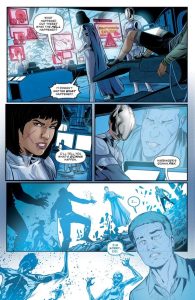
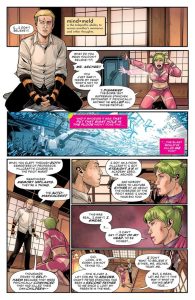
The issue opens with a shocking flashback sequence detailing the moment of the previous issue’s bomb explosion, revealing from the perspective of survivors and medical personnel that the bomb detonates after being disarmed, leaving multiple “Harvester Units” destroyed and a psiot operative named @X apparently comatose with no brain activity detected. Archer returns to his quarters to discover Cici alive and demanding answers. Through a mind meld, Cici reveals her explosive claim: she disarmed the bomb, but Supremum Stanchek detonated it psychically anyway, massacring innocents to turn public opinion against the Human League. Archer resists the revelation, citing weaponized memory implants from the Psiot Wars as a potential explanation, but Cici’s simple question cuts through his denial: if she’s lying about Stanchek’s actions, how is she still alive?
The issue shifts gears when Archer is summoned to a briefing, forcing Cici to hide in his closet. Archer learns he’s been demoted for punching Stanchek and reassigned as a security escort. His girlfriend Charlene, a fellow operative, reveals she’s been offered the position of new field team leader, a role she accepts despite the awkwardness it creates between them. Charlene explains that the Human League has declared war, killing dozens of Steppers under her protection, and someone needs to pursue them aggressively. The conversation underscores Archer’s sense of displacement; he’s been sidelined while the team marches forward without him.
Archer’s new assignment becomes clear: escort Ambassador Maria Azevedo from the Glass City, a representative of the Urban Union reviewing Foundation City’s application for membership. The Urban Union was formed specifically to defend against psiots and Peter Stanchek, making the ambassador’s scrutiny extremely high-stakes for the city’s future. Azevedo’s tour takes a pointed turn when she insists on visiting a women’s prison, where the power dampeners, isolation protocols, and political undertones of incarceration become visible. While touring Cell Block Omega-XX, Archer spots Black Sheep, the terrorist responsible for the previous week’s massacre, imprisoned in the facility.
As Azevedo interviews inmates about fair treatment, a personal moment unfolds: a young man named Corey visits his mother, Lou, an inmate who’s clearly estranged from her son, apologizing for her past failures and urging him to come home. However, during the power dampeners being turned off momentarily for safety protocols, mysterious assassins from a group called Sanction suddenly strike, breaking into the facility. The riot erupts when the power dampeners malfunction, restoring the psiots’ abilities and allowing imprisoned psiot inmates to attempt an escape. The issue ends mid-chaos, with Archer forced to protect Azevedo while the prison descends into violence, and Black Sheep taunting him about payback.
Story
Van Lente’s script juggles multiple storylines and introduces roughly a dozen new concepts (the Urban Union, Sanction assassins, power dampeners, the Glass City, the Psiot Wars, the Supremum’s sermon, the bomb conspiracy, the reassignment). That’s ambitious for a single issue, but it creates a structural problem: nothing gets sufficient room to breathe. Dialogue is punchy and character-driven when focused, with strong banter between Archer and Charlene that feels genuinely intimate.
However, exposition dumps disguised as conversation (the ambassador tour section) grind momentum to a halt. The pacing accelerates abruptly in the final act, shifting from interpersonal drama to full prison riot, which works thematically but feels rushed narratively. The conspiracy revelation in the opening pages should be the issue’s anchor, yet it disappears entirely once Archer leaves his quarters, only to resurface thematically at the very end.
Art
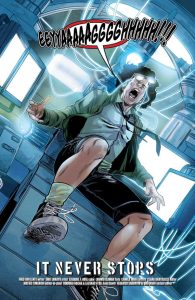
Tamayo’s artwork maintains visual clarity even during the prison riot sequence, a genuine achievement given the density of action and character count. Panels are composed logically, guiding the eye through crowded scenes without sacrificing character recognition. However, the art underserves the tonal range the story demands. The opening conspiracy sequence uses muted, clinical colors that emphasize the tragedy effectively.
By contrast, the prison sequences shift to brighter, more energetic hues that conflict with the oppressive atmosphere they’re supposed to convey. Color choices favor high-contrast reds, blues, and whites, which work for psychic battles but sometimes clash with quieter, more intimate scenes. Character faces remain generally distinct, though some minor characters blur together. The composition excels at wide shots and large group moments but occasionally leaves facial expressions under-rendered during pivotal emotional beats.
Characters
Archer carries the issue’s emotional weight convincingly. His internal conflict, torn between protecting Stanchek’s reputation and acknowledging Cici’s testimony, rings true and grounded. The dynamic with Charlene adds genuine stakes to his demotion; her promotion isn’t presented as betrayal but as her making the harder, more selfless choice. That complexity is refreshing. Cici works as a catalyst but lacks dimension beyond her function as the bearer of bad news. The ambassador serves primarily as a device to force Archer through the prison, limiting her agency as a character. Black Sheep provides antagonistic energy but reads as a one-note villain. Supporting characters like Lou, Corey’s mother, briefly suggest deeper emotional layers that the issue doesn’t have space to explore, a missed opportunity.
Originality & Concept Execution
The premise of a hero discovering his mentor committed mass murder for political gain isn’t new, but applying it to a psiot-dominated superhero narrative with themes of governance, monopoly on power, and institutional corruption adds texture. The Urban Union concept is solid: imagine a league of diverse magical and super-powered cities banding together specifically to contain the threat of unchecked psiot power. That’s conceptually strong. However, execution falters because the issue tries to deliver too much at once. The conspiracy itself, the strongest narrative hook, gets swallowed by exposition about the prison, the Urban Union, the assassins, and the riot. The comic reads less like a cohesive opening chapter and more like a collection of setup beats that haven’t yet found their unified focus.
Positives
The comic’s strongest asset is its willingness to betray trust and complicate the moral landscape. Stanchek’s potential villainy, viewed through Cici’s raw, emotional testimony, challenges everything Archer believes about his mentor and mentor, making this the most genuinely compelling premise the series has offered so far.
The conspiracy hook is genuinely effective and creates real narrative momentum. Archer and Charlene’s relationship carries authentic weight; watching her accept a role that displaces him, paired with her genuine care for his wellbeing, demonstrates the comic understands how to layer motivation and emotion. The visual clarity during action sequences, especially the final prison riot pages, shows Tamayo can handle chaos without sacrificing readability. Van Lente’s dialogue maintains wit and personality throughout, never slipping into exposition-heavy speechifying except where the story deliberately demands it.
Negatives
The biggest issue is pacing wrapped in ambition. Van Lente introduces the Urban Union, the Sanction assassins, the Glass City, multiple new characters, and maintains ongoing Psiot Wars lore all while launching a conspiracy arc. It’s too much for one issue to carry without something suffering, and that something is cohesion. The tonal whiplash from intimate character scenes to sprawling action sequences to exposition-heavy tours disrupts momentum.
The conspiracy revelation, which should dominate the issue’s emotional landscape, gets lost after the opening pages, making it feel incomplete or unresolved rather than strategically delayed. The prison sequence, while visually competent, devotes substantial page space to characters and concepts that lack sufficient establishment to land with full impact. Azevedo’s role feels functional rather than character-driven. The final page twist of the riot erupting during the ambassador’s visit feels convenient rather than organic, placing them precisely where danger strikes rather than having them navigate into jeopardy.
Art Samples:
The Scorecard:
Writing Quality (Clarity & Pacing): [2/4]
Art Quality (Execution & Synergy): [3/4]
Value (Originality & Entertainment): [1/2]
Final Thoughts:
(Click this link 👇 to order this comic)
VALIANT BEYOND: ALL-NEW HARBINGER #4 plants a genuinely compelling seed: Stanchek might be a murderer, and Archer has to live with that knowledge while protecting an ambassador from a city built specifically to oppose him. That’s meaty material. Unfortunately, the comic can’t resist cramming half a dozen other ideas into the same space, diluting the central conflict into background noise. It reads like the first chapter of something potentially excellent, strangled by the need to move multiple plotlines forward simultaneously.
We hope you found this article interesting. Come back for more reviews, previews, and opinions on comics, and don’t forget to follow us on social media:
If you’re interested in this creator’s works, remember to let your Local Comic Shop know to find more of their work for you. They would appreciate the call, and so would we.
As an Amazon Associate, we earn revenue from qualifying purchases to help fund this site. Links to Blu-Rays, DVDs, Books, Movies, and more contained in this article are affiliate links. Please consider purchasing if you find something interesting, and thank you for your support.