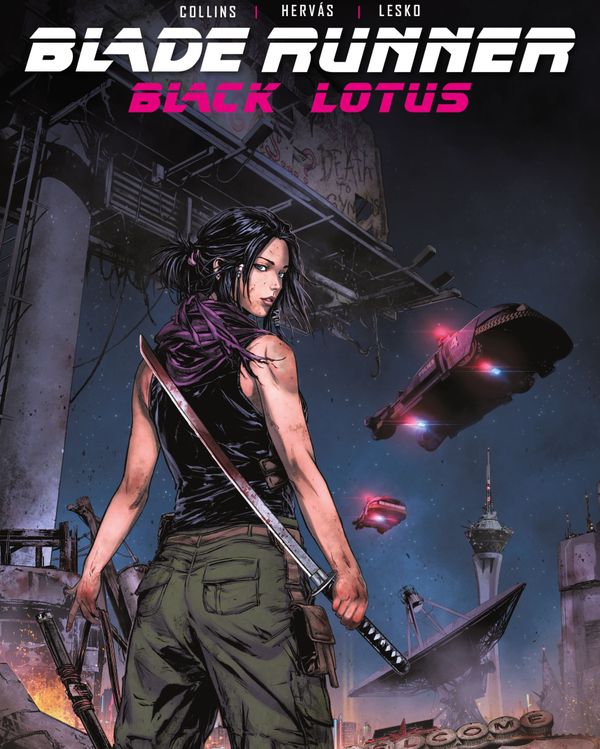
Blade Runner Black Lotus: Las Vegas #4 (Titan Comics, 3/4/26): Writer Nancy A. Collins and artist Jesús Hervás deliver an apocalyptic palace coup as Elle, the Black Lotus replicant, escapes a collapsing Vegas “paradise” in a lore-heavy, concept-rich finale. The execution is visually intense but narratively overburdened by exposition, and the arc closes on a clever yet unsatisfyingly abrupt pivot into a new status quo; Verdict: For die-hard fans only.
Credits:
- Writer: Nancy A. Collins
- Artist: Jesus Hervas
- Colorist: Marco Lesko
- Letterer: Jim Campbell
- Cover Artist: Raymond Gay (cover A)
- Publisher: Titan Comics
- Release Date: March 4, 2026
- Comic Rating: Mature
- Cover Price: $4.99
- Page Count: 32
- Format: Single Issue
Covers:
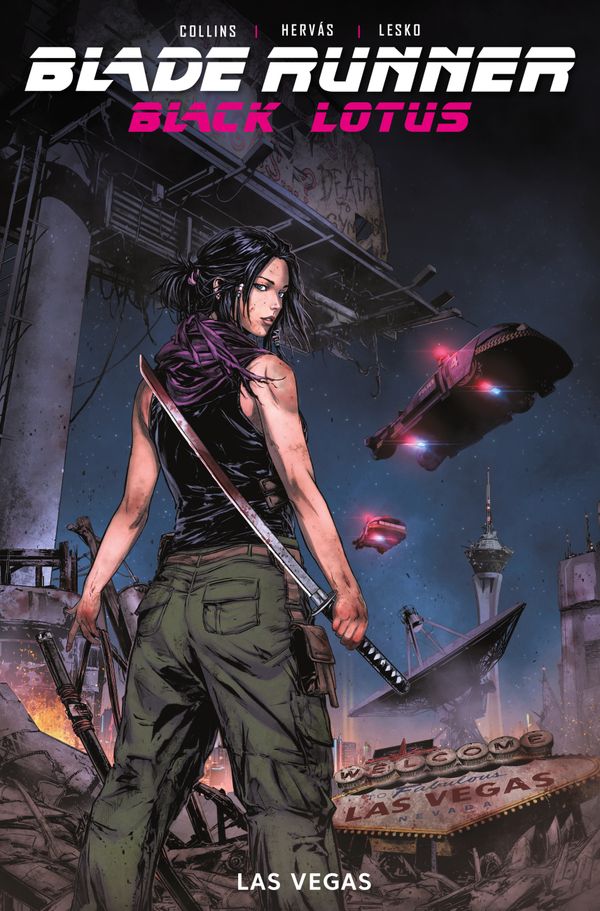
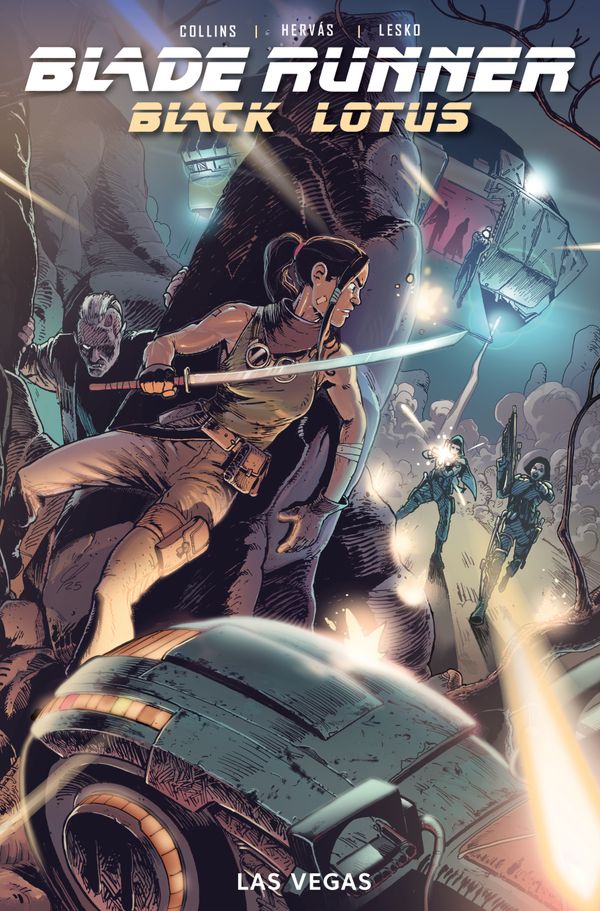
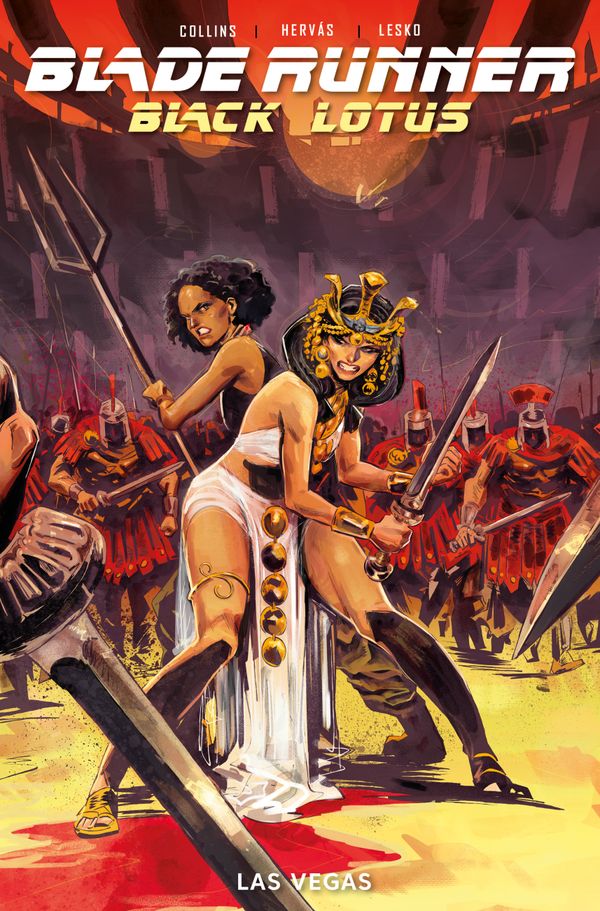
Analysis of Blade Runner Black Lotus: Las Vegas #4:
First Impressions:
This issue opens at a sprint and rarely slows down, hurling Elle from gladiator chaos into outright war between Egyptian and Roman themed replicant factions while the Doll Squad and mercenaries close in from the edges. The energy feels urgent and the imagery hits hard, yet the script keeps pausing mid-sprint to explain past betrayals and corporate schemes in dialogue that reads more like a dossier than a conversation.
By the time Elle finally reaches the Underbelly and meets the Semita, it is clear that the big creative swing is all about reframing Vegas as a layered ecosystem of oppressed communities rather than a simple stopover on her quest. That originality is genuinely engaging, but the emotional climax of the arc never quite lands because major beats, including Niander’s manipulations and Davis’s mission, are spelled out instead of allowed to resonate through action, making the ending feel more like a trailer for the next miniseries than a satisfying resolution.
Recap:
In the previous issue, Elle was welcomed into Cleopatra and Nefertiti’s Egyptian themed Paradise, promised a royal wedding to Julius Caesar, and introduced to the Animoid filled arena where human prisoners fought and died for replicant entertainment until she rebelled against the spectacle. She met Vanna, a human slave whose failed heist with her boyfriend and brother left her trapped in Vegas, and learned that the Semita, a radical sewer dwelling replicant enclave, rejected the Queens’ mimicry of human culture while the Doll Squad and Brekker mercenaries clashed outside the city under Niander Wallace’s orders. The issue ended with Elle refusing to play along with the arena’s cruelty, attacking the Animoid, and being whisked away by a mysterious figure as Julius sentenced her to death for betraying the royal house.
Plot Analysis (SPOILERS):
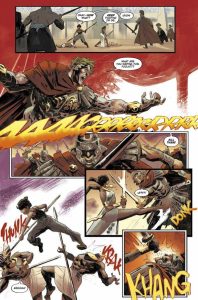
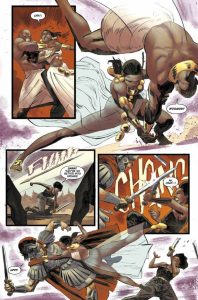
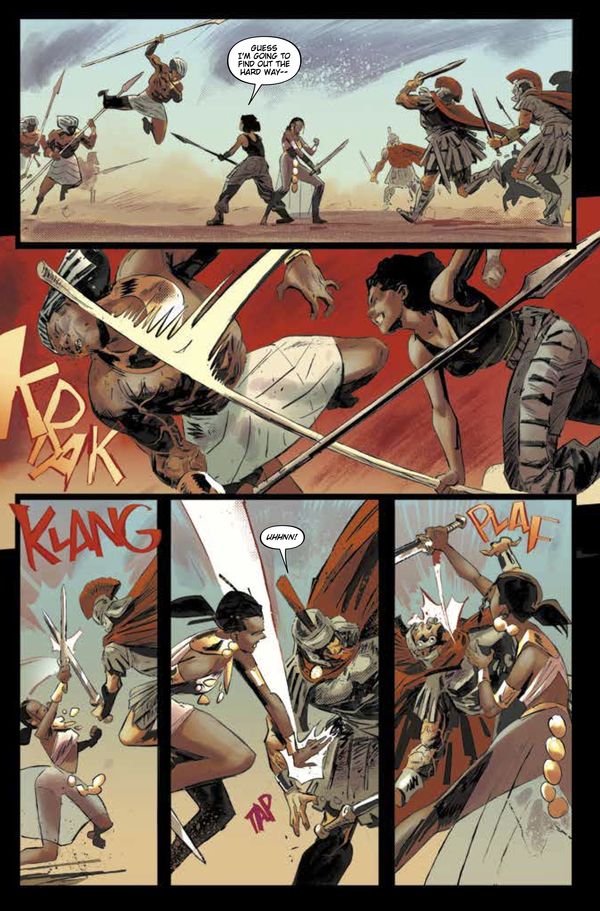
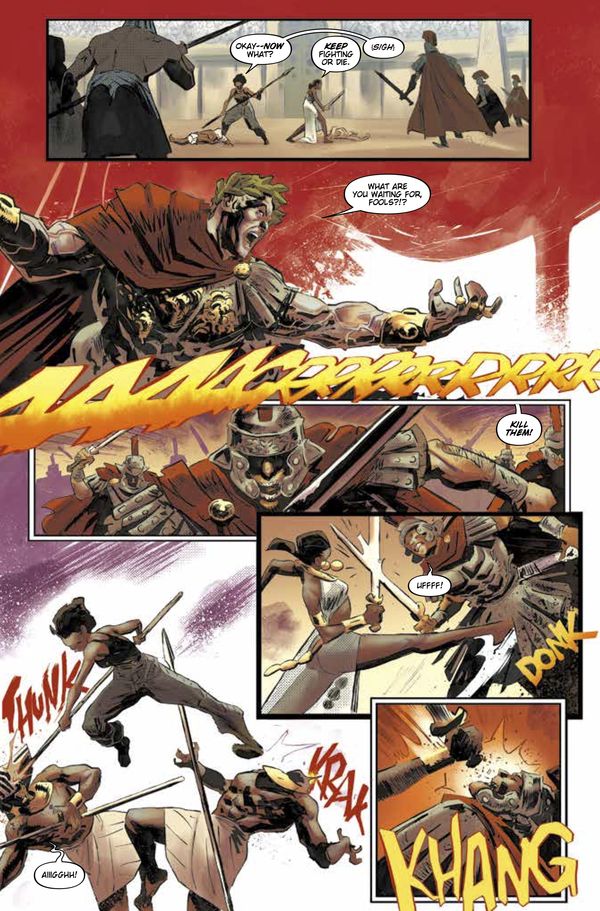
The issue opens in the arena chaos as the supposedly decorative hospitality model replicants prove surprisingly dangerous, forcing Elle and Davis to fight for their lives while Julius screams for their execution from the stands. A brawl between the Egyptian Queens and the Roman leadership erupts when accusations fly about harboring Elle, and Cleopatra insults the Romans’ “mighty empire” until Nefertiti brutally stabs Julius, shattering the fragile Pax Vegas. Cleopatra rallies the Egyptian side as Praetorians react in Latin barked orders, and the once stable “paradise” devolves into open civil war that turns the arena into a battleground.
During the melee, Vanna rushes in to pull Elle and Davis to safety, revealing that she is Cleopatra’s human slave, which shocks Davis and underscores how normalized human servitude has become in this enclave. Vanna guides them through the palace corridors while guards give chase, explaining that she is helping Davis rather than Elle because the former has shown her more basic decency than any of the replicant royalty. As they flee, a narration beat observes that the replicants mimic their human creators to the very end, and the narration notes that years of peaceful coexistence are obliterated in an instant of pent up rage, destroying their shared ecosystem.
Vanna leads them to an access point into the Underbelly, explaining that the tunnels were built to move money and goods beneath the casinos and were later colonized by Las Vegas’s homeless population, then taken over by the Semita. She tells Elle that if her Spinner bike still exists it will be with the Semita, though she warns that they will likely find Elle before Elle finds them. When Elle urges Vanna to come along, Vanna refuses, pointing out that her radiation sickness means she will die faster below and that she would rather accept slavery in Paradise with food and minimal comfort than face starvation or torture elsewhere, a stark choice she contrasts with the illusion of freedom she once had in Los Angeles.
Once in the tunnels, Davis reveals she is on Wallace Corporation business, not ordinary police work, explaining that Niander promised to restore her ability to walk and grant Off World passage for her and her wife if she brought Elle back, and that she was part of a team that Brekker mercenaries nearly wiped out. Elle, in turn, recounts how Niander groomed her as “Black Lotus,” manipulated her emotions to make her believe she loved him, used her as a cat’s paw to kill his father, then tried to erase the evidence by unleashing another replicant, Water Lily, to kill her and anyone who knew the truth. Meanwhile, topside, Menzes’s team takes out Brekker’s mercs in a firefight, finds Davis’s discarded comm unit, and is promptly captured by Roman styled replicants acting on Caesar’s orders just as Paradise erupts in flames, before the narrative returns underground where Elle finally locates the Semita, reclaims her bitten and battered bike, and is warily welcomed into their community with a cheer of “Viva las replicantes” that lands as both invitation and warning.
How is the story in Blade Runner Black Lotus: Las Vegas #4?
Collins keeps the pacing brisk, with quick turns from arena brawl to palace coup to tunnel confessional, yet that speed often comes at the expense of letting crucial moments breathe, especially in the back half. The script frequently halts action scenes to pipe in narration or explanatory dialogue about the tunnels, Vegas history, or Wallace corporate machinations, which undercuts what could have been a more organically tense escape story. When Vanna refuses to leave Paradise, the decision lands as a powerful character beat, but even there her speech leans into thesis statement territory about slavery and perceived freedom instead of trusting the visuals and prior context to carry weight.
Dialogue alternates between sharp, grounded lines, like Vanna’s weary assessment that humanity “rolled the dice and came up snake eyes,” and heavier chunks that read like lore bullet points stitched into conversation. The Niander info dump in the tunnels, where Elle recounts the entire Black Lotus grooming and betrayal, feels like a dossier summary compressed into a few pages, flattening what should be emotionally devastating revelations. Structurally, the issue tries to juggle the Vegas collapse, Elle and Davis’s uneasy alliance, and the Doll Squad’s movements, but the Doll Squad scenes feel bolted on, reappearing mainly to keep them in play rather than to serve the emotional arc of Elle’s story.
How is the art in Blade Runner Black Lotus: Las Vegas #4?
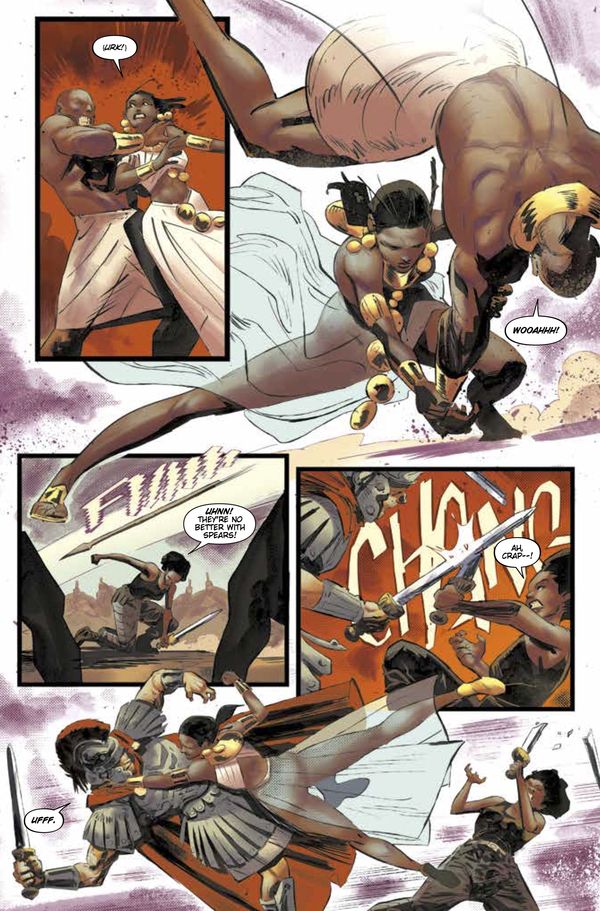
Hervás’s linework remains gritty and expressive, with dense crosshatching and textured environments that sell Vegas as a decaying ruin where every corridor and tunnel feels lived in and dangerous. The arena and palace pages use layered compositions, stacking figures and debris to convey chaos while still keeping panel-to-panel motion readable, and character acting in close ups, especially Vanna’s resigned sadness and Elle’s simmering frustration, comes through clearly. Some crowd scenes in the arena lean into visual noise, yet Lesko’s color choices, with flaming oranges clashing against sickly yellows and cold blues, help separate figures and guide the eye through the action.
The transition into the Underbelly is handled with a smart tonal shift, as colors mute into moldy greens and desaturated browns, signaling a move from gilded oppression to grungy survivalist territory. Panel layouts in the tunnels favor long horizontal slices and narrow verticals that reinforce the feeling of cramped spaces, which visually supports the script’s repeated emphasis on inescapable systems. The reveal of the Semita and Elle’s bike is visually striking, with a wide establishing shot that finally opens the space up and frames Elle as small against a mass of wary replicants, highlighting her status as both asset and potential threat.
Characters
Elle’s characterization stays consistent with earlier issues, torn between her engineered role as an assassin and her personal revulsion at cruelty, yet her biggest emotional beats here occur in monologue rather than in behavior, which dampens their impact. Her choice to save Davis instead of abandoning her is a crucial moral decision, but the issue spends more time having her narrate Niander’s manipulations than exploring how that choice changes her self-image. Davis benefits from the Vegas detour by gaining a clearer motivation, since her Off World dream with her wife finally makes her feel like more than a generic hunter, yet the confession arrives late, buried in tunnel exposition that risks reducing her to a walking contract clause.
Vanna arguably gets the sharpest moment in the book when she chooses to stay in Paradise, accepting a doomed slavery over a shorter, harsher death elsewhere, which makes her both deeply tragic and painfully human. That decision underlines the book’s bleak view of systemic exploitation, but because Vanna exits the story immediately afterward, the emotional fallout is limited. The Semita, introduced as a radical alternative to the palace factions, remain largely conceptual here, chanting slogans and reclaiming Elle’s bike but not yet registering as individuals, which leaves this finale feeling like a handoff to future character work rather than a completed arc.
Originality & Concept Execution
Using Vegas as a fractured city where abandoned hospitality models cosplay ancient empires while a third faction thrives in the sewers is a bold twist on Blade Runner’s usual rain slicked urban decay. The idea that replicants mimic their creators’ empires even as they build new hierarchies of their own is thematically rich and gives this miniseries a distinct identity within the broader franchise. The Semita’s Underbelly lineage, tied to old homeless tunnels and casino money routes, is an inventive way to fold real world Vegas infrastructure into dystopian worldbuilding, underscoring the idea that the city’s underclass never truly disappears, it just changes faces.
Where the book stumbles is in execution, since so many of these concepts are explained outright rather than implied through behavior and setting, which makes the originality feel more academic than visceral in practice. The arc ends not with a resolved Vegas story but with a hard pivot into the Underbelly and a teaser that Elle’s next adventure awaits with the Semita, which undercuts the sense of closure for this four issue run. The result is a finale that crackles with ideas but leaves the promised exploration of those ideas for another series, making this specific issue feel more like a bridge than a destination.
Pros and Cons
Art Samples:
The Scorecard:
Writing Quality (Clarity & Pacing): 2.5/4
Art Quality (Execution & Synergy): 3.5/4
Value (Originality & Entertainment): 0.5/2
Final Thoughts:
(Click this link 👇 to order this comic)
Blade Runner Black Lotus: Las Vegas #4 delivers dense ideas and striking visuals, but it also leans hard on wordy exposition and leaves the central Vegas storyline half finished in favor of teasing the Underbelly sequel. If you have followed Elle from the anime through prior issues and you are invested in every twist of Niander’s fallout, this chapter offers enough conceptual fuel and moody art to justify the spend, though you may still feel shortchanged by the lack of a clean emotional payoff.
Related Posts:


We hope you found this article interesting. Come back for more reviews, previews, and opinions on comics, and don’t forget to follow us on social media:
If you’re interested in this creator’s works, remember to let your Local Comic Shop know to find more of their work for you. They would appreciate the call, and so would we.
Click here to find your Local Comic Shop: www.ComicShopLocator.com
As an Amazon Associate, we earn revenue from qualifying purchases to help fund this site. Links to Blu-Rays, DVDs, Books, Movies, and more contained in this article are affiliate links. Please consider purchasing if you find something interesting, and thank you for your support.