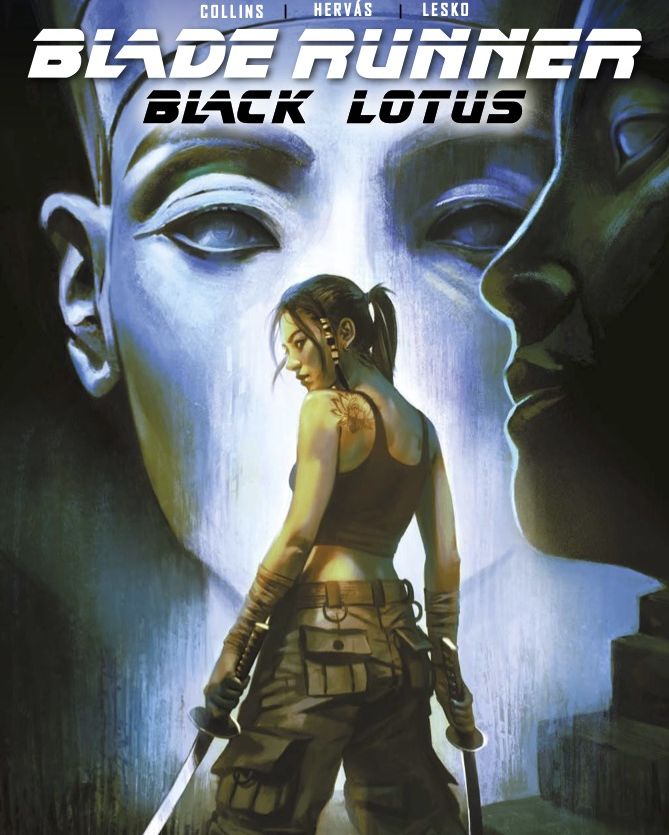
Blade Runner Black Lotus: Las Vegas #3, by Titan Comics on 12/10/25, finds Elle trapped in a gilded cage of replicant royalty, where being made a princess feels a lot like being made a prisoner, and the real horrors come dressed in the finest fashions Vegas has to offer.
Credits:
- Writer: Nancy A. Collins
- Artist: Jesus Hervas
- Colorist: Marco Lesko
- Letterer: Jim Campbell
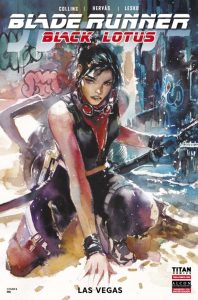
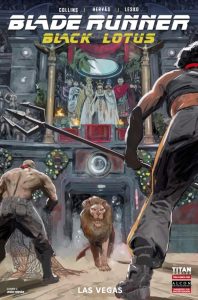
- Cover Artist: Claudia Caranfa (cover A)
- Publisher: Titan Comics
- Release Date: December 10, 2025
- Comic Rating: Mature (language, violence)
- Cover Price: $4.99
- Page Count: 34
- Format: Single Issue
Covers:


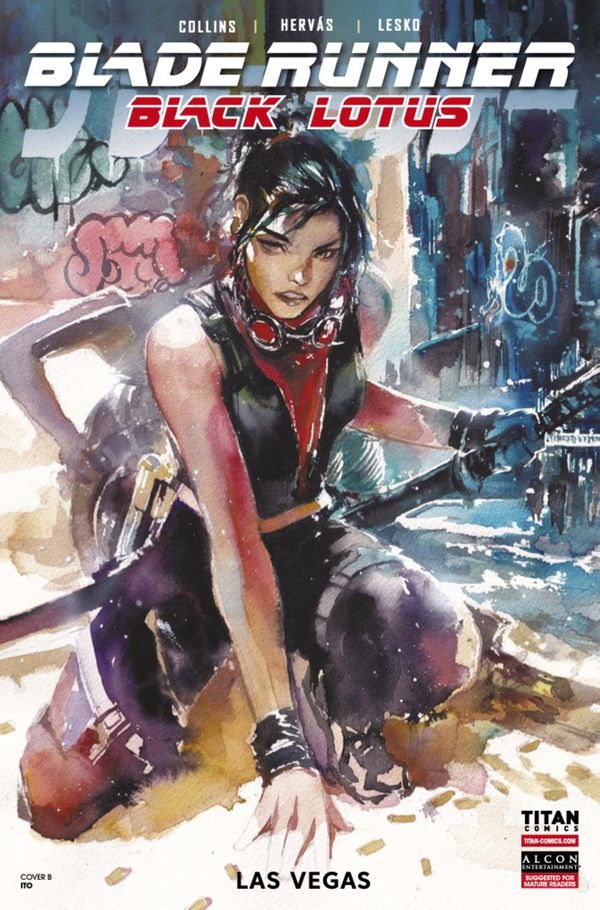
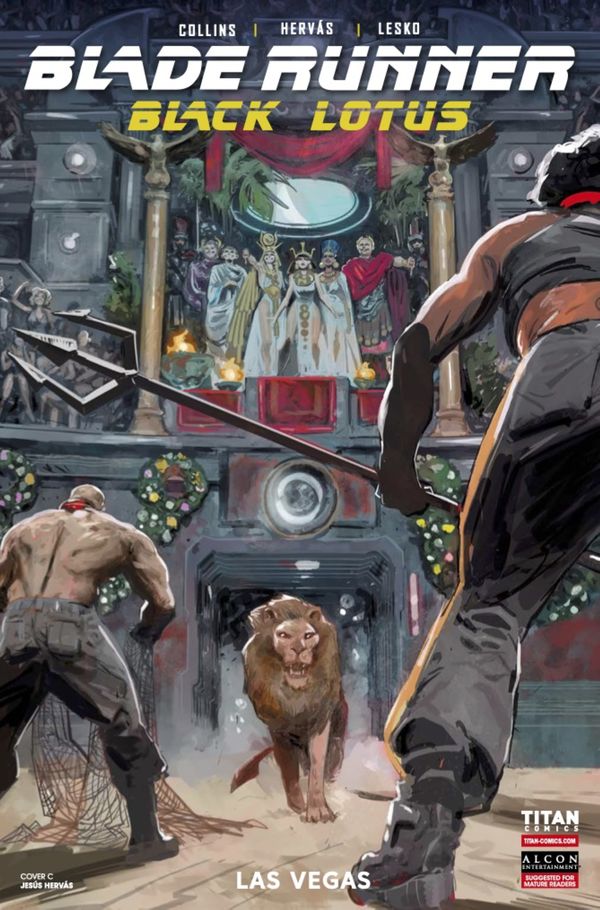
Analysis of BLADE RUNNER BLACK LOTUS: LAS VEGAS #3:
First Impressions:
The opening exchange crackles with quiet tension as Elle realizes her newfound status is just another cage. The pacing drops into something more intimate and character-driven than the previous issue, letting us sit with Elle’s dawning horror that safety and freedom aren’t the same thing. It’s a strong pivot that immediately hooks you with the question: what’s Elle going to do about being trapped by her own kind?
Recap:
In Blade Runner Black Lotus: Las Vegas #2 introduced Elle to the “Queens of Egypt,” Cleopatra and Nefertiti, who rule over replicants in the Paradise Hotel Casino in irradiated Las Vegas. When Elle’s serial code came up missing, the male emperors Julius, Caligula, and Nero questioned whether she was human. Elle revealed she was created by Niander Wallace as an assassin. Meanwhile, Niander’s Doll Squad tracked her to Vegas but suffered heavy losses when Brekker Solutions mercenaries ambushed them, resulting in the deaths of Smith, Brown, and Kozlov, the capture of Davis, and the remaining squad members being seized by Caesar’s soldiers.
Plot Analysis:
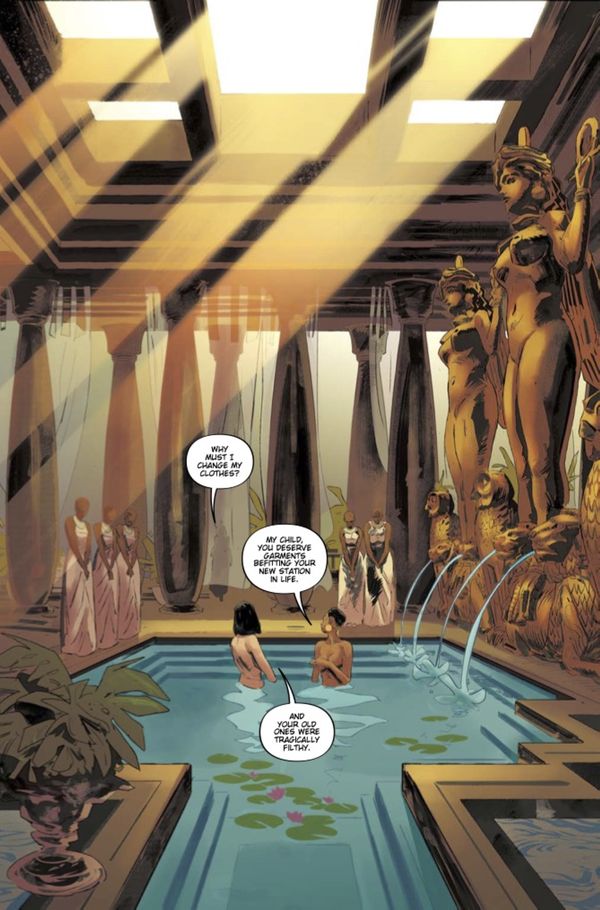
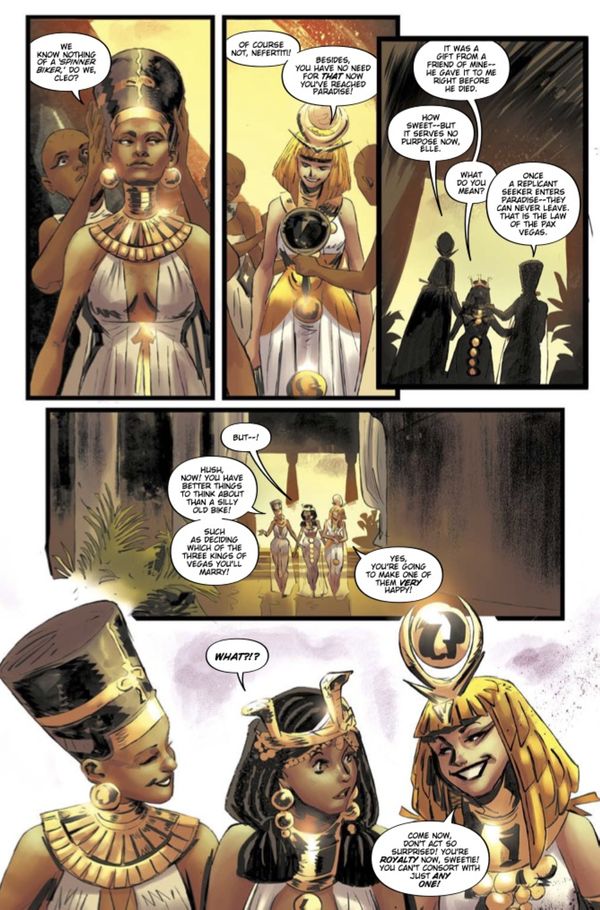
Elle is brought before Cleopatra and Nefertiti, who dress her in fine clothes and announce she’ll become a princess to Vegas replicant royalty. The queens introduce her to the concept of Paradise, explaining that any replicant who enters can never leave and that she’ll marry one of the three kings.
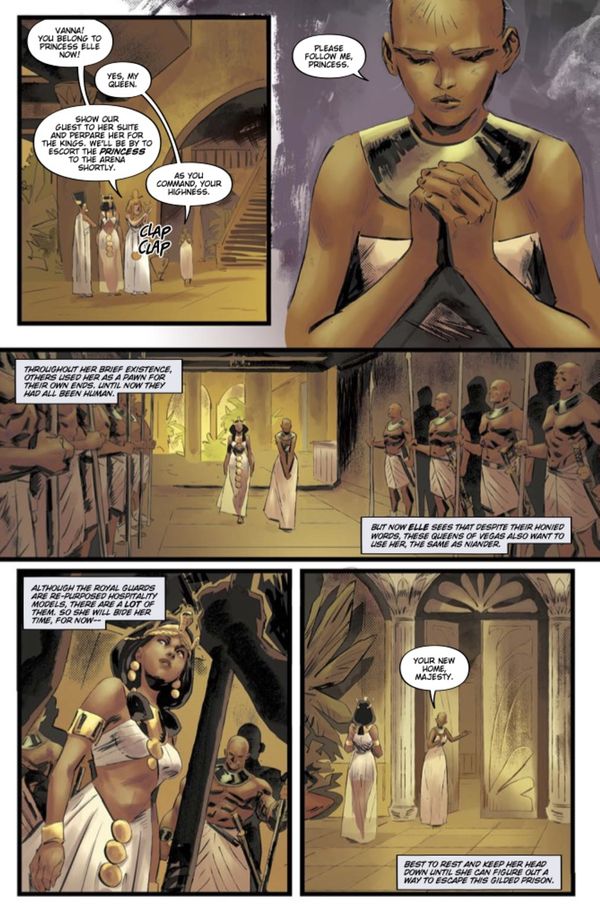
Elle meets Vanna, a human slave who was brought to Vegas six months earlier with her boyfriend Pascal and brother Everett. Vanna explains how they planned to raid the casinos for gold and money, only to be ambushed by Caesar’s soldiers. Pascal was killed, her brother was sentenced to the arena, and Vanna became Cleopatra’s handmaiden. Despite the radiation slowly killing her, Vanna accepts her fate as better than starving in Los Angeles. Elle realizes her only escape depends on finding her Spinner bike.
Meanwhile, Menzes receives orders from Tyler about the situation in Vegas. The Doll Squad has suffered massive casualties from the Brekker mercenaries, and corporate refuses to send backup. With Davis missing and the team bloodied, Menzes and the remaining agent decide to finish what they started. In the palace, the queens prepare Elle for her public debut in the arena, explaining that other replicant enclaves like the Semita exist in the sewers beneath Vegas. These radical, technology-worshipping replicants refuse to recognize the Pax Vegas and despise replicants who mimic human culture.
Elle is brought to the arena where the three kings (Julius, Caligula, and Nero) hold an event in her honor. Elle witnesses humans forced to fight to the death in the arena, wearing bomb collars, and when Officer Davis appears in the chaos trying to protect Elle, a creature called an Animoid is released. Elle refuses to watch more deaths and attacks the creature, refusing to participate in the spectacle. She’s caught by a mysterious figure who tells her to follow, and as they escape the arena, Julius sentences her to death for betraying the royal house.
Story
Nancy Collins steers the narrative into smaller, more personal spaces compared to issue #2’s spectacle overload. The pacing slows deliberately when Elle and Vanna talk, trading exposition for something that actually breathes. Vanna’s monologue about her fall from hunger to slavery lands emotionally because it shows rather than explains her resignation to her fate. However, the dialogue still carries the weight of world-building that sometimes pushes character interaction into the background. Lines like “turnaround is fair play” and the repeated references to “Pax Vegas” feel like Collins reminding readers of the stakes rather than letting characters naturally discover them.
The structure holds steady throughout, with clear scene transitions between Elle’s palace storyline and the Doll Squad’s scattered operations. The arena sequence finally delivers the explosive momentum the story has been building toward, and Elle’s refusal to watch humans die creates genuine moral conflict. That said, the cliffhanger ending arrives abruptly, cutting off just as the tension reaches peak temperature.
Art
Jesus Hervas continues to command the page with sharp, detailed line work that makes every texture matter, from the grimy palace walls to the ornate clothing Elle wears. The color palette from Marco Lesko shifts subtly throughout issue #3, moving from warm sand and gold tones in the palace sequences to harsh, acidic yellows and reds in the arena, creating immediate visual distinction between comfort and violence.
Composition is particularly strong in the arena scenes, where Hervas uses angles and layering to amplify the chaos and scale of the crowd. The bomb collars, the weapons, the sprawling arena itself all feel physically present. However, some quieter moments between Elle and Vanna get crowded with panel density that occasionally obscures emotional clarity. The Animoid design pops visually but arrives with little explanation, leaving its purpose unclear beyond “dangerous arena monster.” Panel transitions flow smoothly, keeping action sequences kinetic and readable even during the most chaotic stretches.
Characters
Elle’s arc in this issue crystallizes her core conflict: being wanted isn’t the same as being free. She moves from cautious acceptance to visceral rejection of the replicant royal structure, showing growth that feels earned. Her connection with Vanna serves the story well, as Vanna’s broken hope mirrors what Elle refuses to accept. The problem is that the queens, despite their intelligence and cruelty, remain more aesthetic than psychological. Cleopatra speaks in grand declarations about replicant supremacy, but we never see her inner motivation beyond conquest and control. The three kings blur together as interchangeable despots.
Officer Davis appears briefly and feels shoehorned in, a reminder of subplot threads that haven’t been properly developed since issue #1. The Semita replicants are introduced as dangerous “radicals” but lack specificity or presence beyond dialogue warnings. Vanna is the exception, her backstory grounding the story’s stakes in personal loss.
Originality & Concept Execution
The concept of replicants building their own empire from nuclear ruin remains fresh and visually arresting. Deploying Egyptian and Roman mythology as a framework for replicant politics is clever, allowing Collins to explore hierarchies and servitude from both angles simultaneously. Issue #3 doesn’t break new thematic ground but deepens the question: if replicants recreate human cruelty, what makes their freedom meaningful? That’s solid philosophy wrapped in action. The arena spectacle mirrors ancient Rome deliberately, making the parallel explicit, and Elle’s refusal to participate becomes an ideological stand as much as an escape attempt.
The execution lands the big moments, particularly Elle’s breakdown during the games and her sudden rescue. However, the pacing of revelations sometimes outpaces emotional weight. You know the queens are cruel, you know the arena is horrific, but the script tells you both simultaneously instead of letting horror accumulate. The Semita faction hints at ideological opposition but remains underdeveloped, a concept waiting for exploration rather than a threat carrying impact.
Positives
Issue #3 finally breaks away from pure exposition and lets character conflict drive the narrative forward. Vanna’s scenes with Elle provide the emotional anchor the story needed, making the stakes personal rather than abstract. The arena sequence showcases Hervas and Lesko’s finest work, with the color shift from gold to sickly yellow immediately signaling danger without a word of dialogue. Elle’s refusal to participate in the games marks a genuine turning point in her character arc, showing her choosing mortality over complicity.
The art team deserves particular praise for making the replicant royalty visually distinct through costume and architecture, transforming a casino into a plausible seat of power. The mysterious rescue at the issue’s climax injects uncertainty and promise of greater complexity ahead. Collins also plays with irony effectively, showing how replicants built by humans copied human cruelty perfectly, turning servitude into sovereignty without changing the fundamental abuse beneath the surface.
Negatives
The pacing stumbles whenever dialogue prioritizes lore over character. Cleopatra’s explanations about the Semita and various Vegas factions read like lecture notes despite being delivered with royal flair. Officer Davis feels dropped into the story without sufficient setup or presence to justify her sudden appearance in the arena. The cliffhanger ending cuts off before we understand who rescued Elle or why, leaving the dramatic momentum suspended in a way that feels incomplete rather than compelling. The Animoid creature serves the plot but arrives with zero context, and its design, while visually striking, raises questions the script doesn’t answer.
Some quieter scenes suffer from panel crowding that muddies rather than clarifies emotional beats. The three male emperors never distinguish themselves as individuals, functioning as a single antagonistic unit without personality. The issue also doesn’t fully justify why the Doll Squad subplot exists in the broader structure of this issue. Menzes and his team get pages and panels but accomplish little narratively, which dilutes the focus from Elle’s dilemma. Additionally, the tonal shift between Elle’s palace experiences and the brutal arena happens quickly, potentially whiplashing readers if they weren’t prepared for escalation.
Art Samples:



The Scorecard:
Writing Quality (Clarity & Pacing): 3/4
Art Quality (Execution & Synergy): 2/4
Value (Originality & Entertainment): 1.5/2
Final Thoughts:
(Click this link 👇 to order this comic)
BLADE RUNNER BLACK LOTUS: LAS VEGAS #3 proves that Elle’s real enemy isn’t the empire trying to capture her, but the replicant royalty trying to domesticate her. The issue lands its core moment, Elle’s refusal to participate in staged violence, and uses that to ask a sharper question: can freedom built on another’s oppression ever be real? Hervas and Lesko remain the issue’s secret weapon, transforming monotonous exposition into visual spectacle that actually sustains momentum. However, the script sometimes forgets that silence is louder than legend, burying character development under layers of world-building explanation.
We hope you found this article interesting. Come back for more reviews, previews, and opinions on comics, and don’t forget to follow us on social media:
If you’re interested in this creator’s works, remember to let your Local Comic Shop know to find more of their work for you. They would appreciate the call, and so would we.
As an Amazon Associate, we earn revenue from qualifying purchases to help fund this site. Links to Blu-Rays, DVDs, Books, Movies, and more contained in this article are affiliate links. Please consider purchasing if you find something interesting, and thank you for your support.