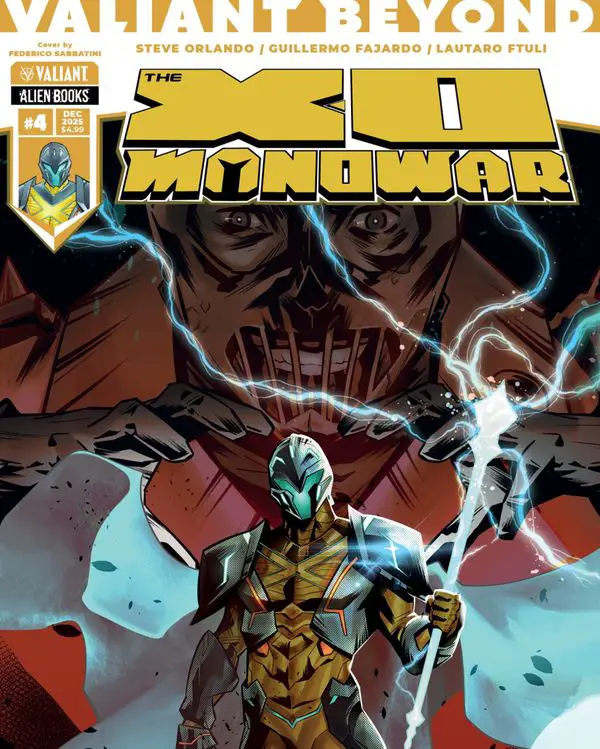
Valiant Beyond: X-O Manowar #4, by Alien Books & Valiant Comics on 12/24/25, watches a two-thousand-year-old soldier get psychologically dismantled before rising again to answer an armor’s cryptic call for help.
Credits:
- Writer: Steve Orlando
- Artist: Guillermo Fajardo
- Colorist: Lautaro Ftuli, Ludwig Olimba
- Letterer: Camila Jorge
- Cover Artist: Federico Sabbatini, Mafuriah (cover A)
- Publisher: Alien Books, Valiant Comics
- Release Date: December 24, 2025
- Comic Rating: Teen
- Cover Price: $4.99
- Page Count: 24
- Format: Single Issue
Covers:
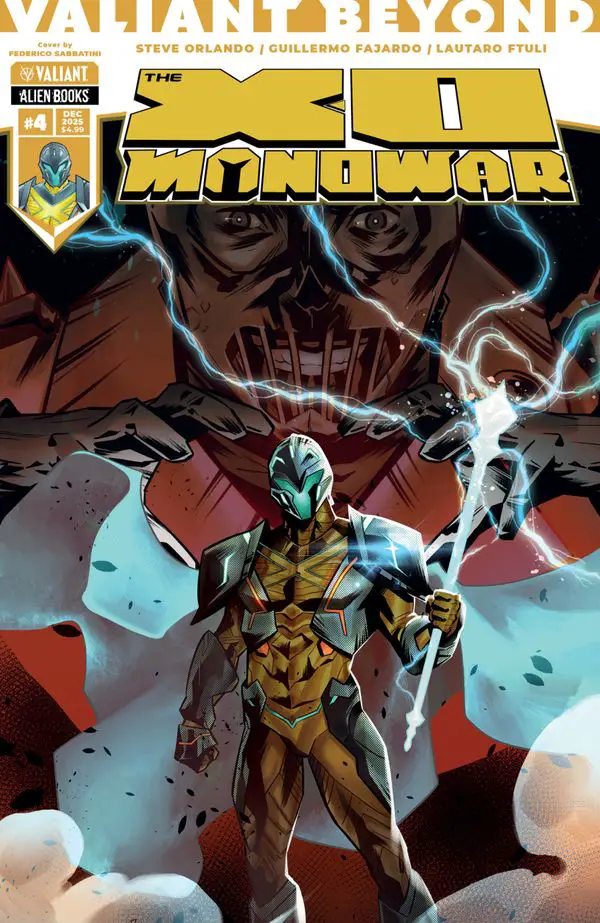
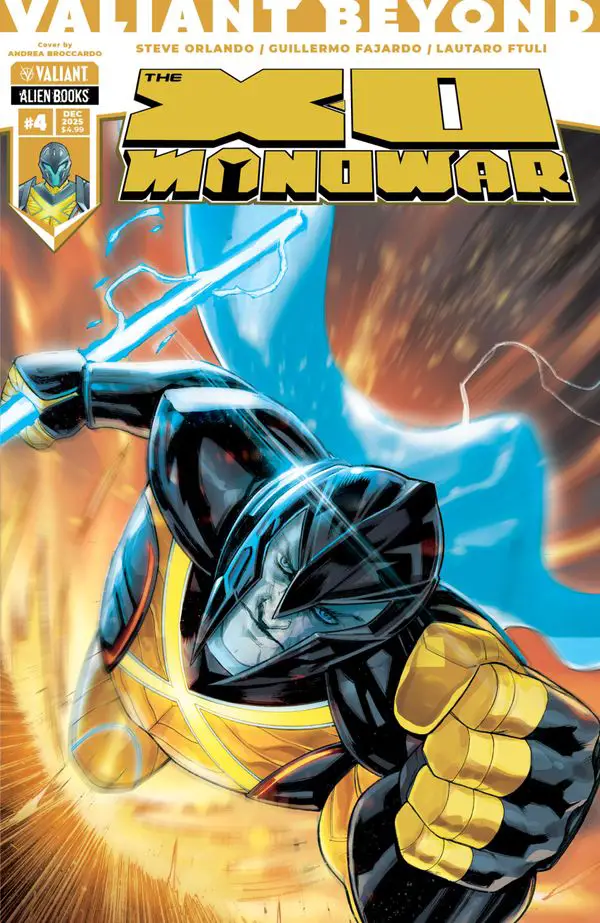
Analysis of VALIANT BEYOND: X-O MANOWAR #4:
First Impressions:
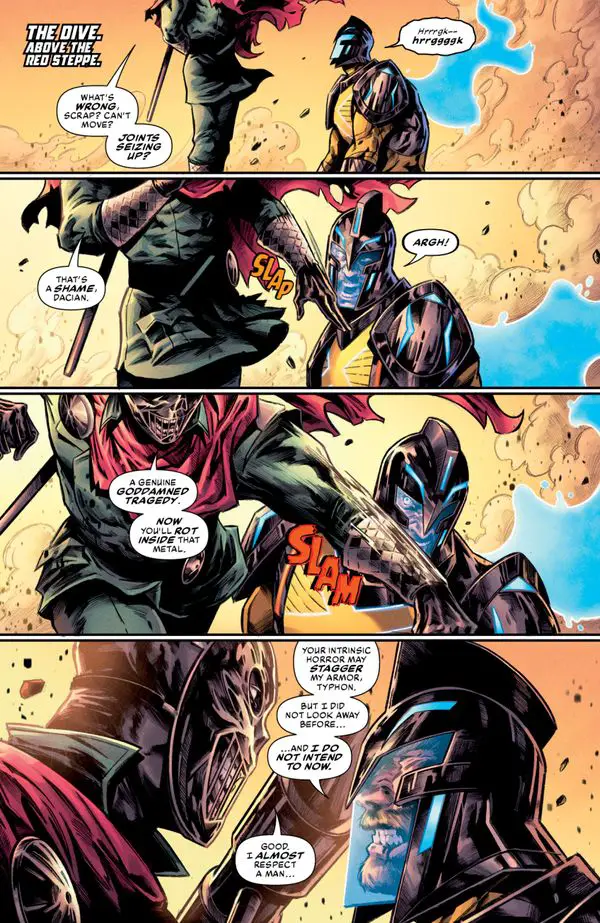
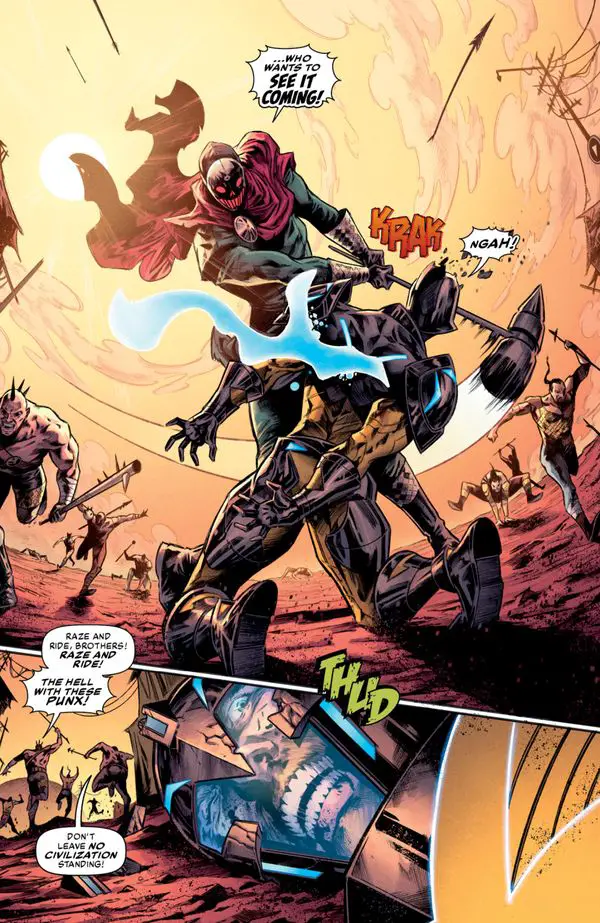
The opening confrontation between Aric and Typhon creates immediate tension through sharp, insulting dialogue that feels genuinely personal rather than generic villain posturing. When Aric drives his armor’s fist into Typhon’s face and declares he will not look away from fear, the entire tone crystallizes into something darker and more introspective than typical superhero brawling. The gut reaction is that this issue pivots from external action into internal reckoning, and that gamble mostly pays off.
Recap:
In Valiant Beyond: X-O Manowar #3, Aric found himself enmeshed in the Punx’s desperate defense of the Dive after rescuing Demolition and others from the Earthborn’s brutal marketplace of flesh and spectacle. The Nose, a moral anchor of the community, died triggering a strange supernatural inheritance while the settlement braced for Typhon’s full assault. Aric had promised a defiant stand on the mountain, but Typhon’s psychic horror ability froze him solid inside his armor, leaving the Dacia warrior locked in absolute terror as Typhon closed in for what looked like the kill.
Plot Analysis:
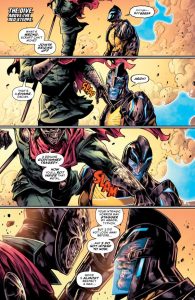
The issue opens with Aric and Typhon already locked in brutal combat, with Aric’s armor trembling as he forces his will against Typhon’s intrinsic horror field. Aric breaks free through sheer defiance, landing a solid punch that draws blood, then hurls Typhon down the mountainside to buy seconds. The Earthborn forces scatter across the mesa toward the Dive’s location, whooping and vowing destruction while Typhon boasts he has already won the psychological war by freezing Aric once. Aric channels what looks like desperation, but Typhon’s taunting about the Dive’s fate and his own unchallengeable power provokes Aric into revealing that he will do whatever is necessary to protect these people, including abandoning his armor entirely.
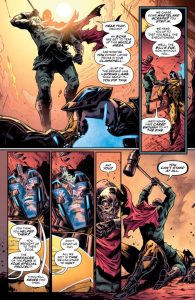
Aric tears the armor off and confronts Typhon bare-handed, declaring that he was a Visigoth warrior long before he ever wore the cosmic suit. He explains that the Romans used fear as a weapon against his people, and they learned to master it through pure cultural will. This recontextualization of his power strips Typhon of his advantage because Aric’s psychological resistance comes from ancient bloodline conditioning, not armor technology. Aric pounds Typhon relentlessly, each blow landing harder as Typhon’s confidence collapses, until finally Aric breaks him completely. The issue shifts into the aftermath, where Demolition negotiates with the leaderless Earthborn survivors, offering them one choice: disband and disperse, or face collective judgment from the Punx.
The story then jumps forward slightly to show the Earthborn departing in apparent defeat, with Aztlan and other Punx members processing the surreal victory. Aric stands battered and bloodied but triumphant while the survivors begin evaluating what comes next, and Demolition extends an offer: join the Punx permanently and help rebuild what the conflict destroyed. When Aric hesitates, Demolition reveals something crucial that reframes the entire arc, sharing that he has examined Aric’s armor and discovered the entity within it has a name: Shanhara. More shocking still, Demolition reveals that Shanhara is not gone or abandoning Aric out of spite. She is suffering, terrified, and in need of rescue from somewhere deeper than the physical world can reach. This revelation transforms Aric’s quest from simple survival and honor into an urgent rescue mission with personal stakes.
Story
The pacing tears between two completely different storytelling energies. The opening battle between Aric and Typhon moves at genuine combat speed, with exchanges of violence and taunt that keep momentum sharp and stakes visible. Dialogue during the fight crackles with character voice, particularly Typhon’s escalating desperation masquerading as confidence and Aric’s bone-deep commitment to protecting people he barely knows. The script earns every punch through clear motivation and mutual respect between opponents.
However, the moment Aric tears off his armor, the issue pivots into monologue territory where Aric explains Visigoth cultural history, Roman military tactics, and his personal connection to fear. This exposition dump, while thematically relevant, grinds pacing to a crawl in the middle of a one-on-one duel. The structure recovers somewhat in the aftermath sequences where Demolition negotiates with the Earthborn and later reveals Shanhara’s identity, but readers expecting a lean action issue instead receive a philosophy seminar dressed in superhero clothing.
Art
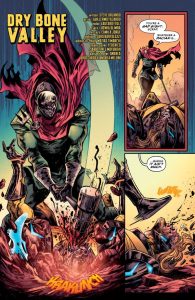
Guillermo Fajardo delivers his strongest work in the violent exchanges, composing panels that track Aric’s fists and Typhon’s reactions with crystal-clear staging that makes each impact feel consequential. The moment Aric removes his armor deserves particular praise because it reads as genuine vulnerability rather than simple nudity. Fajardo draws Aric smaller without his suit, physically diminished, which forces readers to square that visual contradiction against the character’s declaration of strength. This compositional choice does heavy narrative work that the script could not accomplish alone.
The color work from Lautaro Ftuli maintains the series’ burnt, exhausted palette while subtly shifting to cooler tones as Aric gains advantage, visually communicating momentum shift without dialogue support. However, the latter portions of the issue, when characters stand around talking about next steps and cosmic entity names, feel static and stagey. Figures occupy space rather than inhabit scenes, and the long exposition about Shanhara’s suffering does not receive visual language complex enough to support the emotional weight the dialogue is trying to carry.
Characters
Aric’s motivation crystallizes beautifully in this issue by moving beyond abstract honor and into concrete, personal stakes. His willingness to discard his armor signals growth from previous issues where he clung to it as identity rather than tool. The Visigoth backstory feels earned because the script has been suggesting his warrior culture matters as much as his cosmic armor, and this issue finally makes that explicit.
Typhon’s character arc completes less satisfyingly because his defeat hinges on his own psychological brittleness rather than Aric outthinking a complex antagonist. Typhon talks endlessly about his power and inevitability, then crumbles when his power fails, suggesting he was never a fully realized person, just a trauma engine. Demolition emerges as the issue’s most consistent character, demonstrating leadership by both fighting and negotiating, then showing genuine insight into technology and people that recontextualizes his earlier admission about struggling with human connection. The revelation that he can read Shanhara’s condition adds dimension by suggesting his AI upbringing gave him unique tools rather than permanent limitations.
Originality & Concept Execution
The concept of a two-thousand-year-old warrior choosing to face his terror unarmored feels fresh in a landscape of power-armor stories where the suit is always the answer. The cultural memory of Visigoth fear-mastery provides originality that pure willpower narratives typically cannot reach. However, the execution stumbles because the issue does not show this fear-mastery in action clearly enough. Aric declares it repeatedly, but the art does not visualize his internal resistance the way Typhon’s horror was portrayed in previous issues.
The bigger originality question centers on Shanhara’s revelation: the armor entity has a name, a condition, and apparently an entire internal story that exists parallel to Aric’s external quest. This pivots the series premise from “warrior vs. wasteland” to “warrior + AI girlfriend in crisis,” which either feels like a natural deepening or a tonal whiplash depending on reader investment in cosmic love stories.
Positives
The standout achievement here is the physical fight itself, which uses sequential art at its finest to communicate power, desperation, and character simultaneously. Aric’s bare-handed domination of Typhon after removing his armor carries visual and thematic punch that makes readers believe a two-thousand-year-old warrior can beat a fear-wielding tyrant through sheer accumulated experience. The character work on Demolition, particularly his offer to help rebuild and his shocking revelation about Shanhara, adds emotional resonance and forward momentum in a climax that could have felt empty after the villain falls.
The dialogue between Aric and Demolition in the aftermath feels honest and grounded, trading philosophical speeches for genuine admission of loss, rebuilding, and next steps. Fajardo’s composition choices during the armor-removal moment demonstrate that artist can do subtle character work as effectively as he handles action beats, and that versatility elevates the issue above simple superhero spectacle.
Negatives
The middle section where Aric explains Visigoth history and fear mastery derails pacing at the exact moment readers need maximum tension instead of lecture material. The exposition could have been handled through action instead of speech, showing Aric resist fear rather than telling readers about ancient warrior conditioning. Typhon’s weakness feeling like pure character fragility rather than Aric’s specific counter-strategy makes the villain less interesting and the victory less earned.
The sudden introduction of Shanhara’s name and suffering status, while conceptually intriguing, drops enormous lore without sufficient space to explore emotional resonance. Readers get told Aric must save an armor entity he has been separated from, but the issue does not provide enough context for why this matters beyond abstract loyalty to his queen. For an issue that begins in violence, the ending moves toward abstraction and setup that leaves readers hanging without closure.
Art Samples:



The Scorecard:
Writing Quality (Clarity & Pacing): [1.5/4]
Art Quality (Execution & Synergy): [3/4]
Value (Originality & Entertainment): [1.5/2]
Final Thoughts:
(Click this link 👇 to order this comic)
VALIANT BEYOND: X-O MANOWAR #4 delivers a satisfying personal victory for Aric while accidentally proving that this series works better when it trusts action and character moments over explaining mythology. The fight itself justifies the issue, but the detours into cultural exposition and armor-entity lore suggest the series is getting more complicated rather than clearer. If your pull list needs a warrior learning to shed dependencies and face fear with ancient will rather than cosmic tech, this lands solid enough to hold a slot.
We hope you found this article interesting. Come back for more reviews, previews, and opinions on comics, and don’t forget to follow us on social media:
If you’re interested in this creator’s works, remember to let your Local Comic Shop know to find more of their work for you. They would appreciate the call, and so would we.
Click here to find your Local Comic Shop: www.ComicShopLocator.com
As an Amazon Associate, we earn revenue from qualifying purchases to help fund this site. Links to Blu-Rays, DVDs, Books, Movies, and more contained in this article are affiliate links. Please consider purchasing if you find something interesting, and thank you for your support.