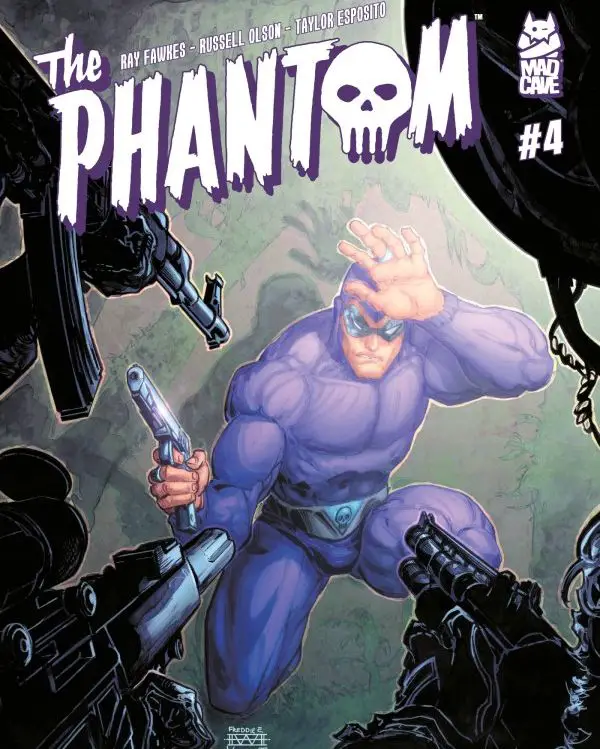
The Phantom #4, by Mad Cave Studios on 1/7/26, picks up where Singh’s ultimatum left Kit Walker with an impossible choice: surrender within the hour or watch the village’s children die.
Credits:
- Writer: Ray Fawkes
- Artist: Russell Olson
- Colorist: Russell Olson
- Letterer: Taylor Esposito
- Cover Artist: Freddie Williams II (cover A)
- Publisher: Mad Cave Studios
- Release Date: January 7, 2026
- Comic Rating: Teen
- Cover Price: $4.99
- Page Count: 34
- Format: Single Issue
Covers:
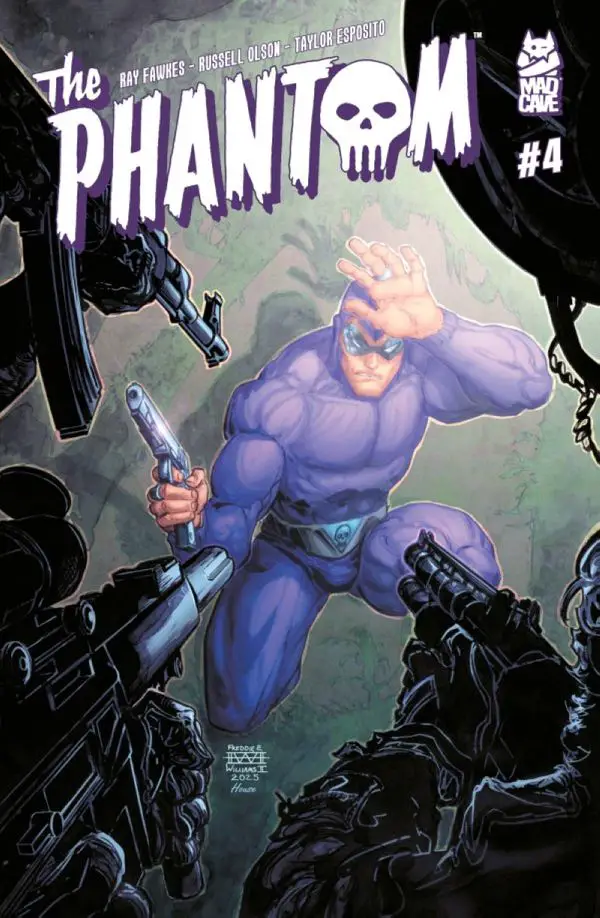
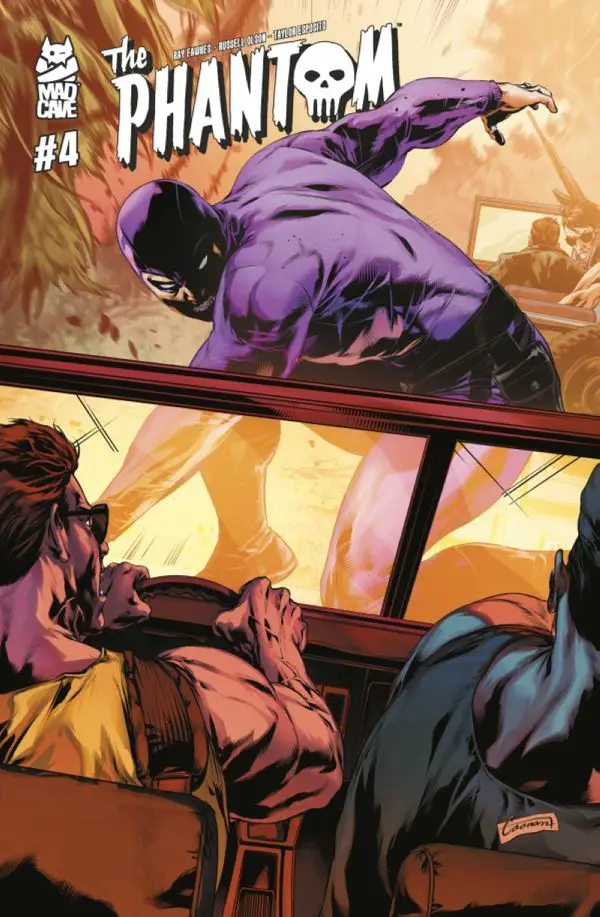
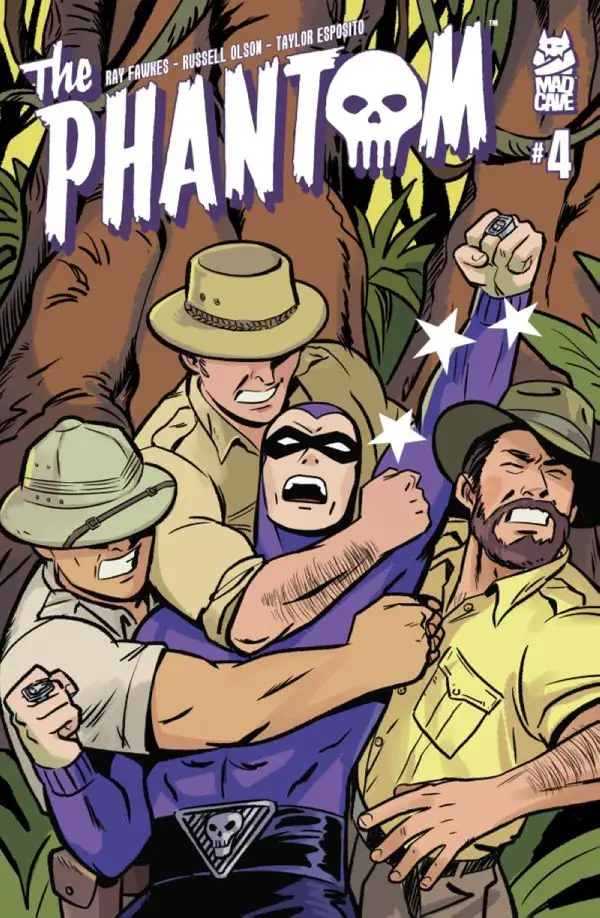
Analysis of THE PHANTOM #4:
First Impressions:
The opening pages hit hard with genuine dread. The shift from Kit’s near-invulnerability in previous issues to genuine vulnerability creates immediate emotional stakes that feel different from the cat-and-mouse games we’ve seen before. Russell Olson’s panel composition places the reader inside the jungle chaos rather than observing it, and that immersive approach makes the desperation feel claustrophobic and real.
Recap:
The Phantom #3 closed with Kit trapped in a tactical nightmare of Singh’s design. The village was under siege, the power cut, children separated from families as hostages, and snipers positioned with crosshairs ready. Singh had positioned himself to eliminate the Phantom through force of overwhelming numbers and psychological warfare, giving Kit one hour to turn himself in or watch the village’s future burn. With the stakes so high, fans eagerly anticipate the phantom series latest issue to see how Kit navigates the harrowing choices ahead. Will he sacrifice himself to save the villagers or devise a daring plan to outsmart Singh? The tension builds as readers are left to wonder if the Phantom can break free from his dire predicament in time.
Plot Analysis (SPOILERS):
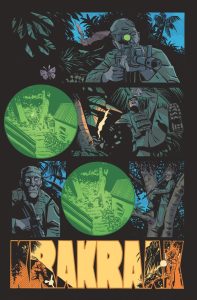
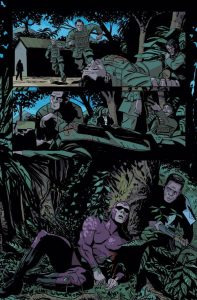
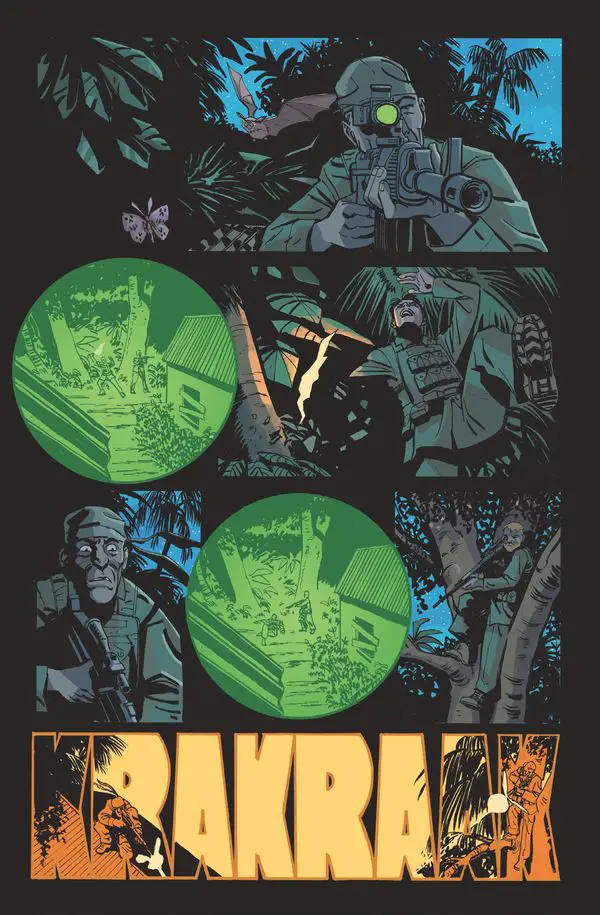
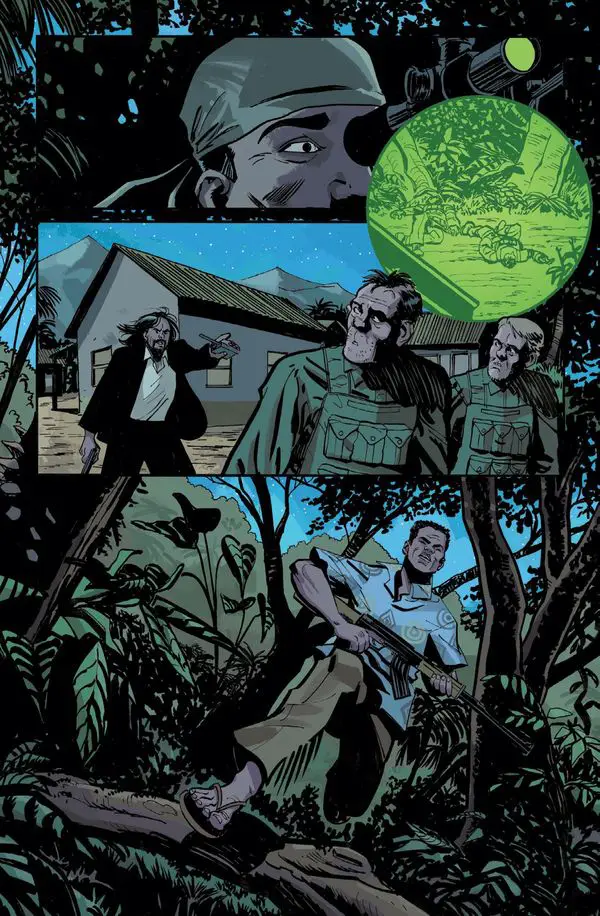
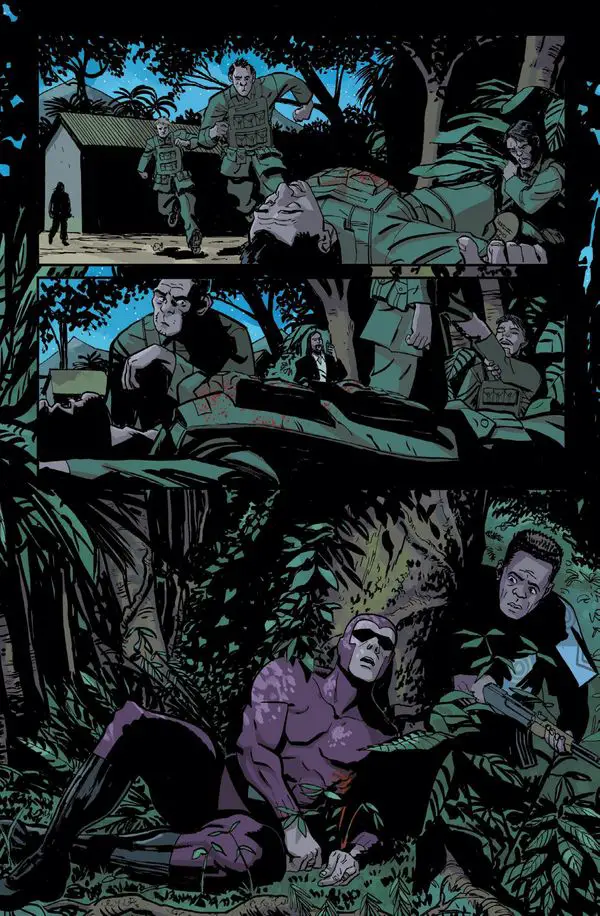
The issue opens with Singh’s soldiers locked in position, snipers ready as they scout the jungle for Kit. A sniper team catches movement and fires, hitting their target with what appears to be a kill shot. Guran hears the gunfire and instinctively runs toward the sound, fearing his friend is dead. He discovers Kit wounded and bleeding, carrying him through the dangerous forest while Singh’s trackers pursue them relentlessly. The pair reach a safe house where Diana, Kit’s wife, works frantically to tend his wound, stemming the blood loss while soldiers close in outside.
Guran orchestrates an escape through the jungle itself, using the Phantom’s ancient traps and environmental knowledge against Singh’s Brotherhood. Guran becomes Kit’s distraction, leading pursuit teams away, deeper into the forest. When Singh’s trackers corner Guran, he’s picks the trackers off one-by-one; the issue shows Singh’s soldiers discovering snares designed to incapacitate rather than kill, and the radio communications between Singh’s teams descend into chaos as they encounter traps set long ago by previous Phantoms. Guran seizes control of Singh’s communication channels and broadcasts the legend of the Phantom directly to the troops, psychologically breaking their discipline and confidence.
Singh, frustrated by the chaos and mounting losses, decides to force the issue. He broadcasts his own ultimatum directly to the Phantom, revealing that he now holds the village’s children in custody and demands Kit turn himself in to the village courtyard within one hour. Singh stakes his reputation as a tactical commander on being able to capture or kill the Phantom, refusing to accept that a legend could outmaneuver his superior firepower and numbers. The issue ends with Kit facing an impossible choice: surrender his freedom and likely his life to save innocent children, or allow them to face execution by the merciless Singh Brotherhood.
Story
Ray Fawkes structures this issue as a series of contrasting scenes that shift perspective between Kit’s internal struggle and Singh’s growing frustration. The pacing feels deliberately split in two halves. The first half moves quickly through action and pursuit, cutting between the sniper team, Guran’s flight with the wounded Kit, and Diana’s medical work. Each scene is tight and functional, serving the purpose of establishing Kit’s actual vulnerability. The second half slows considerably, focusing on Guran’s psychological warfare and Singh’s response, allowing dialogue and character reaction to carry the narrative weight.
Fawkes uses Kit’s wounded state to justify why he can’t simply outfight his way through this problem, which is smart character-driven storytelling. Dialogue is minimal but purposeful. Diana’s reassurances to Kit and her own doubts about her medical skills ground the emotional reality of the situation. Singh’s broadcasts reveal a man losing patience with the game of cat and mouse, shifting from tactical commander to frustrated antagonist willing to risk everything on one final confrontation.
However, the structure has a notable weakness. The middle section where Guran is establishing traps and planning his psychological counterattack lacks clear visual or narrative explanation. Readers understand the broad strokes, but the specific mechanics of how Guran seized control of the communications network or how he moved from the safe house to positioning himself for psychological warfare aren’t clearly explained. The issue jumps between establishing shots and dialogue without bridging the tactical planning that justifies Guran’s confidence in orchestrating this comeback.
Art
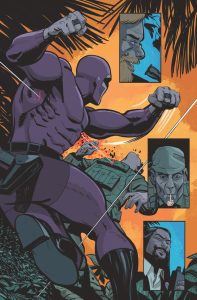
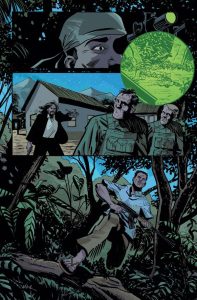
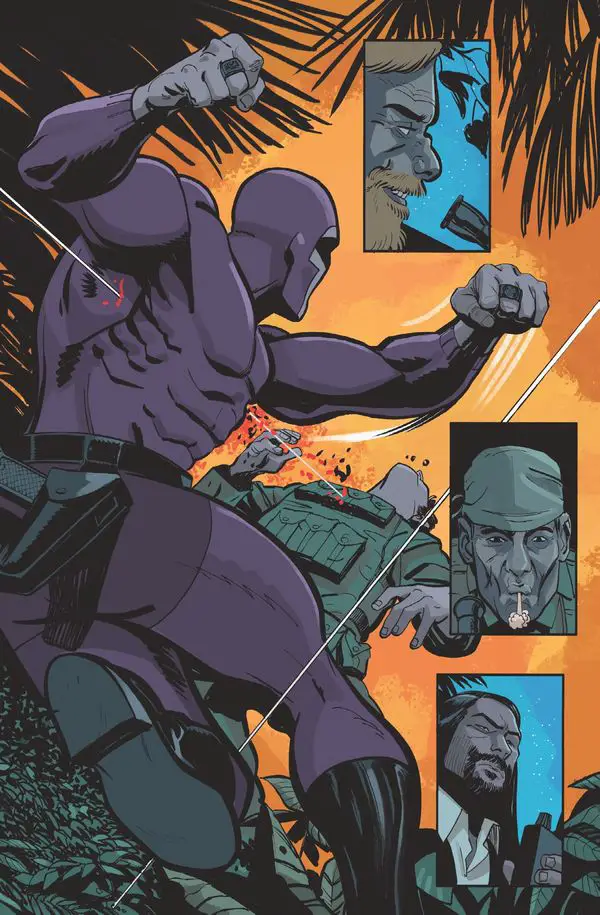
Russell Olson’s artwork captures the visceral reality of Kit’s wound early in the issue. The close-ups of blood, the care with which Diana handles his injury, and the physical vulnerability in Kit’s posture all communicate that this is not a supernatural invulnerability but a genuine human being in danger. The jungle itself is rendered with impressive atmosphere, using deep greens and shadows to create a sense of danger around every tree and vine. Olson uses negative space effectively to suggest the vastness of the forest while keeping claustrophobic tension in the foreground.
However, the technical execution falters during the sequences depicting Guran’s trap deployments and psychological counterattack. The panels showing the Brotherhood soldiers encountering the Phantom’s ancient traps are difficult to parse visually. Readers can see soldiers reacting with shock and fear, but the actual mechanics of the traps remain unclear. During the radio communication sequence where Guran broadcasts the legend, Olson relies heavily on close-ups of Singh’s face and radio equipment, which effectively conveys Singh’s emotional state but leaves the reader disconnected from Guran’s actual position and what he’s physically doing to accomplish this feat.
The color palette maintains mood exceptionally well throughout. The dark jungle greens and shadows of the first half shift slightly toward warmer interior tones during Diana’s medical scene, creating emotional separation from the outdoor danger. Singh’s final ultimatum scene uses stark, clinical lighting that matches his emotional coldness. The issue’s visual strength lies in mood and character expression rather than clarity of action sequences.
Characters
Kit Walker demonstrates genuine growth in this issue through his willingness to admit limitation. He’s wounded, his tactics haven’t eliminated the threat, and he’s now facing a situation where his legendary skills can’t prevent civilian casualties. His internal struggle between legendary responsibility and human fear of failure feels authentic. His motivation remains consistent with previous issues: protect the village, keep Diana safe, and preserve the Phantom’s legacy of protecting the innocent.
Guran proves himself emotionally central to Kit’s story, becoming Kit’s literal lifeline when the sniper fire wounds him. The relationship between the two men is shown rather than told, and it rings true. Diana emerges as a stronger character this issue, shifting from background support to active participant in Kit’s survival. Her medical competence and emotional devotion ground Kit in humanity; she refuses to let him die, and that conviction becomes a form of strength.
Singh evolves from calculating antagonist to frustrated commander willing to sacrifice his strategic advantage for a decisive victory. His decision to demand Kit’s surrender represents emotional escalation from pure tactics to personal pride. This makes him more interesting as a character, though his psychological motivation could be deeper. The Brotherhood soldiers remain largely faceless, though individual dialogue reveals varying levels of belief in the Phantom’s legend, which adds texture to how the troops react.
Originality & Concept Execution
This issue attempts something bold: making the Phantom genuinely vulnerable by wounding him and removing his tactical advantage. That’s a meaningful departure from the invincible legend archetype, and Fawkes commits to the premise. The psychological warfare sequence where Guran broadcasts the legend directly to the troops is clever, using the Phantom’s mythology as a tactical weapon against soldiers’ morale. However, the execution of this idea lacks visual clarity, which undermines its impact.
The overall premise remains familiar. Wounded hero confronting overwhelmingly superior force isn’t original. Singh’s ultimatum about hostage children recycled from issue three creates a sense of repetitive stakes rather than escalation. The issue executes these familiar elements competently, but doesn’t transcend them. There’s no surprising thematic turn or bold narrative choice that distinguishes this from standard action-adventure storytelling. The premise is “Kit must survive Singh’s trap,” and the issue delivers that, but without the innovation or risk that would elevate it beyond competent genre work.
Positives
The emotional vulnerability this issue introduces transforms Kit from invincible legend into a sympathetic character facing impossible odds. Diana’s presence and her determination to save his life become the emotional heartbeat of the first half, making readers invest in Kit’s survival as a human being rather than as a symbol. Russell Olson’s art during the medical scene is tender and effective, contrasting sharply with the surrounding violence. The decision to wound Kit early removes readers’ confidence that he’ll simply outsmart and outfight his way through the problem, which creates genuine tension about whether he can actually succeed.
The psychological warfare sequence where Guran seizes the communications channels and broadcasts legend directly to the troops is conceptually smart, using narrative power as a tactical weapon. Singh’s growing frustration conveys his emotional escalation, making him a more three-dimensional antagonist than in previous issues. The jungle setting continues to work as a character in itself, with Olson’s rendering of dense vegetation and ancient traps suggesting that the Phantom has generations of advantages built into his environment.
Negatives
The issue’s greatest weakness is narrative clarity during its crucial middle sequences. Readers understand Kit is wounded, Guran is leading pursuit away and positioning himself for a psychological counterattack, but the specific mechanism of how Guran seizes control of communication networks and where he positions himself to broadcast remain frustratingly vague. This undermines the intellectual satisfaction of following Guran’s tactical planning, which is supposed to be the core appeal of the character.
The visual execution of trap sequences falls short of what the story requires. When Singh’s soldiers encounter the Phantom’s ancient snares, Olson’s panels convey emotional reaction and danger, but the actual mechanics of how these traps function become muddy. This is particularly problematic because Guran’s tactical brilliance depends on readers understanding that these traps are working as planned.
The repetition of hostage stakes feels like narrative wheel-spinning rather than escalation. Issue three ended with Singh holding children as leverage; issue four recycles this exact stake rather than introducing a new layer of consequence. This makes the stakes feel static rather than mounting. Singh’s character development from pure tactician to emotionally invested antagonist is interesting, but remains surface-level. His motivations involve pride and reputation, but no genuine complexity emerges to suggest why he’s willing to commit genocide to prove his superiority. The issue also lacks the kind of specific character moments or dialogue that would differentiate it from generic action-adventure storytelling. Kit’s voice remains somewhat generic, and the broader cast of characters remains underdeveloped.
Art Samples:
The Scorecard:
Writing Quality (Clarity and Pacing): [3/4]
Art Quality (Execution and Synergy): [3/4]
Value (Originality and Entertainment): [1.5/2]
Final Thoughts:
(Click this link 👇 to order this comic)
THE PHANTOM #4 commits to introducing genuine vulnerability to its protagonist, which is narratively courageous and emotionally effective during the early sequences. Kit Walker wounded becomes a more interesting character than Kit Walker invincible, and Diana’s role becomes meaningful rather than decorative. However, the execution falters during the crucial middle passages where tactical planning should engage the reader’s intellect. The issue obscures rather than clarifies how Guran seizes the advantage, leaving readers disconnected from the intelligence that supposedly defines him and his supporting cast. As readers seek a thorough understanding of the plot, a new comic review for phantom series could provide insights into the series’ strengths and weaknesses. Analysis of character development and pacing will be crucial, particularly in how they impact the reader’s engagement. It will be interesting to see if future issues can successfully navigate these challenges and deliver a satisfying narrative experience.
We hope you found this article interesting. Come back for more reviews, previews, and opinions on comics, and don’t forget to follow us on social media:
If you’re interested in this creator’s works, remember to let your Local Comic Shop know to find more of their work for you. They would appreciate the call, and so would we.
Click here to find your Local Comic Shop: www.ComicShopLocator.com
As an Amazon Associate, we earn revenue from qualifying purchases to help fund this site. Links to Blu-Rays, DVDs, Books, Movies, and more contained in this article are affiliate links. Please consider purchasing if you find something interesting, and thank you for your support.