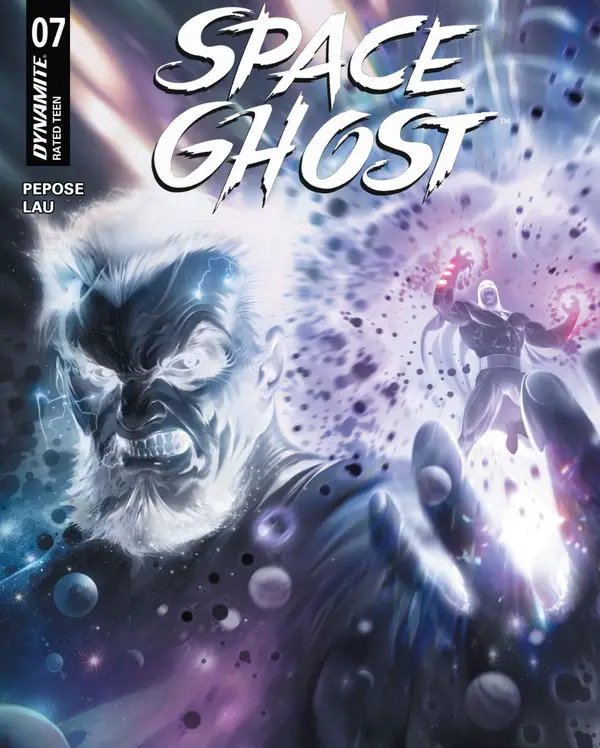
Space Ghost (Vol. 2) #7, by Dynamite Comics on 1/14/26, trades the vampire horror of the previous issue for a high-stakes corporate sabotage story that suddenly spirals into something far darker.
Credits:
- Writer: David Pepose
- Artist: Jonathan Lau
- Colorist: Andrew Dalhouse
- Letterer: Taylor Esposito
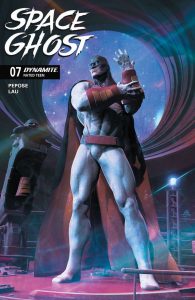
- Cover Artist: Francesco Mattina (cover A)
- Publisher: Dynamite Comics
- Release Date: January 14, 2026
- Comic Rating: Teen
- Cover Price: $4.99
- Page Count: 24
- Format: Single Issue
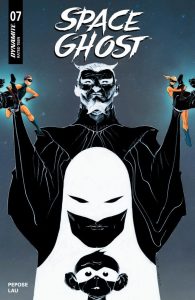
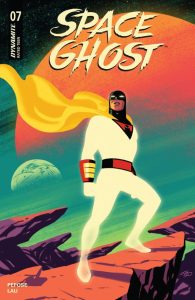
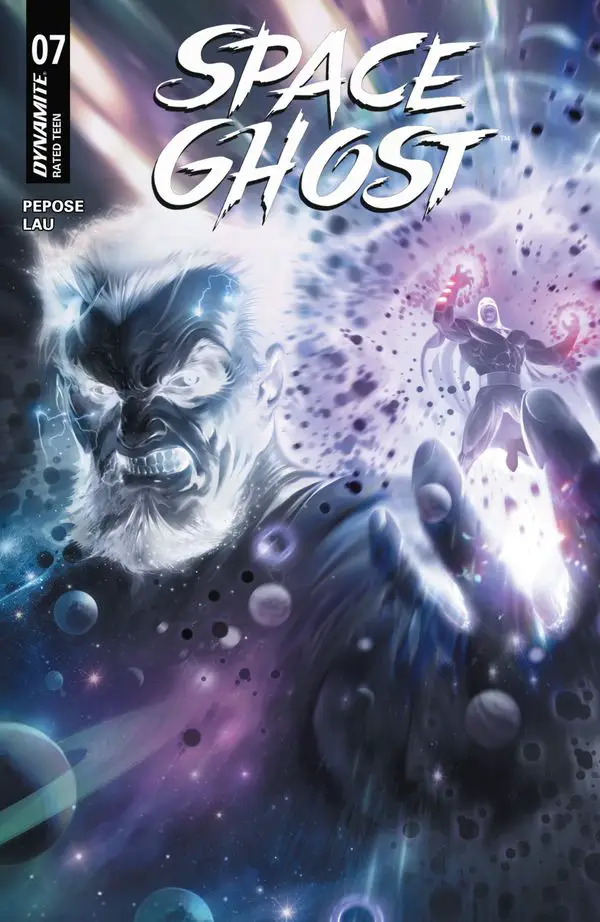
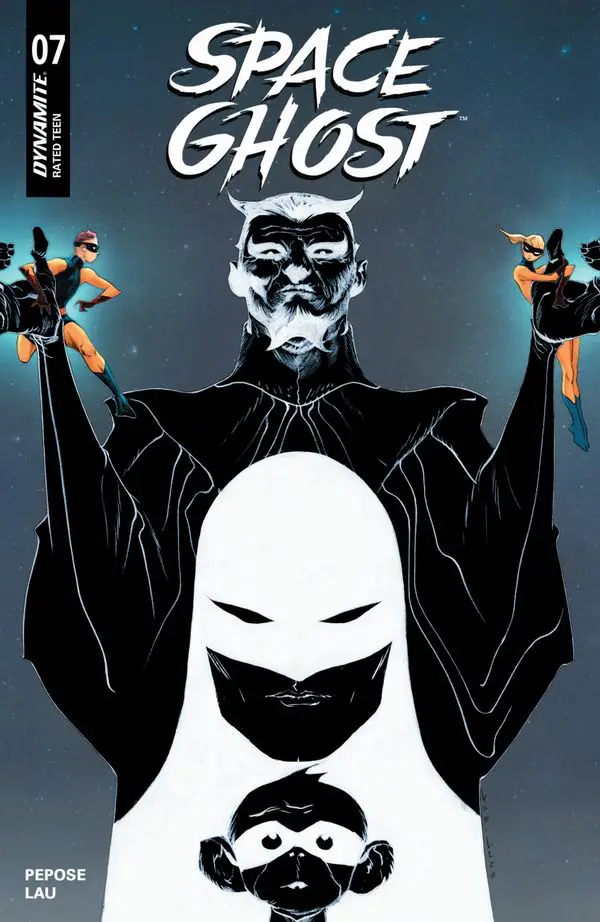
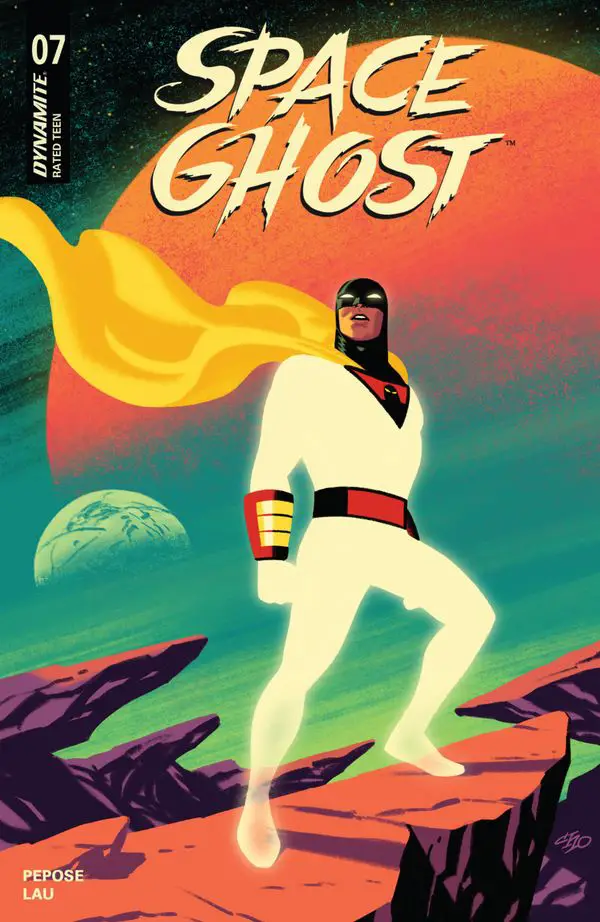
Covers:
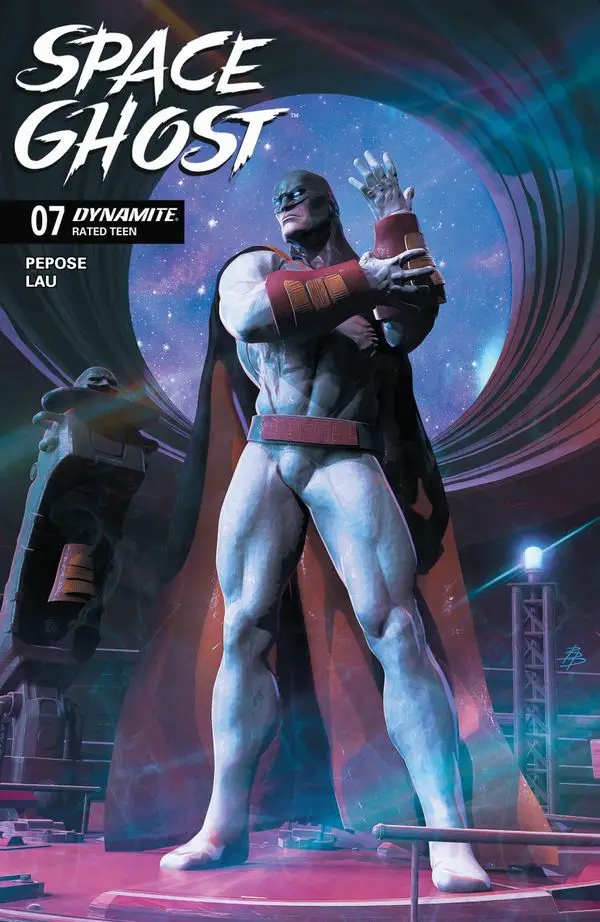
Analysis of SPACE GHOST (VOL. 2) #7:
First Impressions:
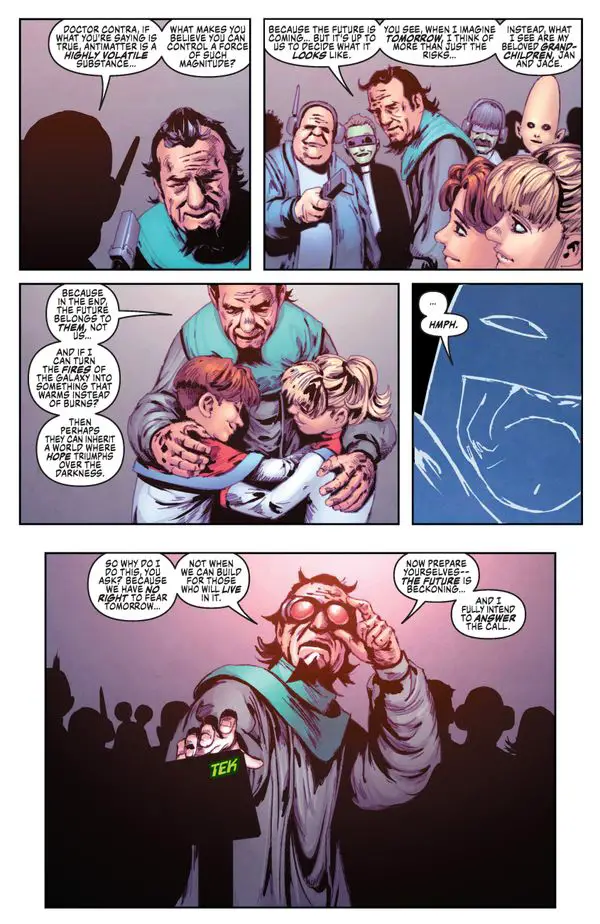
The opening pages immediately grab you with a corporate espionage setup that feels deliberately grounded, establishing stakes through boardroom conversation instead of explosions. What makes this work is how quickly the tone shifts from “elegant science presentation” to “everything is about to explode,” turning Doctor Contra’s heartfelt speech about building a better future into tragic irony. It is a gutsy narrative choice that respects the reader’s intelligence while setting up massive consequences.
Recap:
In Space Ghost (Vol. 2) #6, the team responded to a silent alarm at Space Station Cosmos, discovering the crew had been transformed into “Forvalokka” vampires. Space Ghost was bitten and became a mindless monster, forcing Jan and Jace to improvise a rescue mission. Using sunlight as their weapon in an eclipse-shrouded sector, they manually overrode the solar array while fighting in the vacuum of space. With the vampire horde incinerated and the Vampire King destroyed, Space Ghost returned to normal, and the team regrouped with renewed unity before teasing the Antimatter Man as the next threat.
Plot Analysis (SPOILERS):
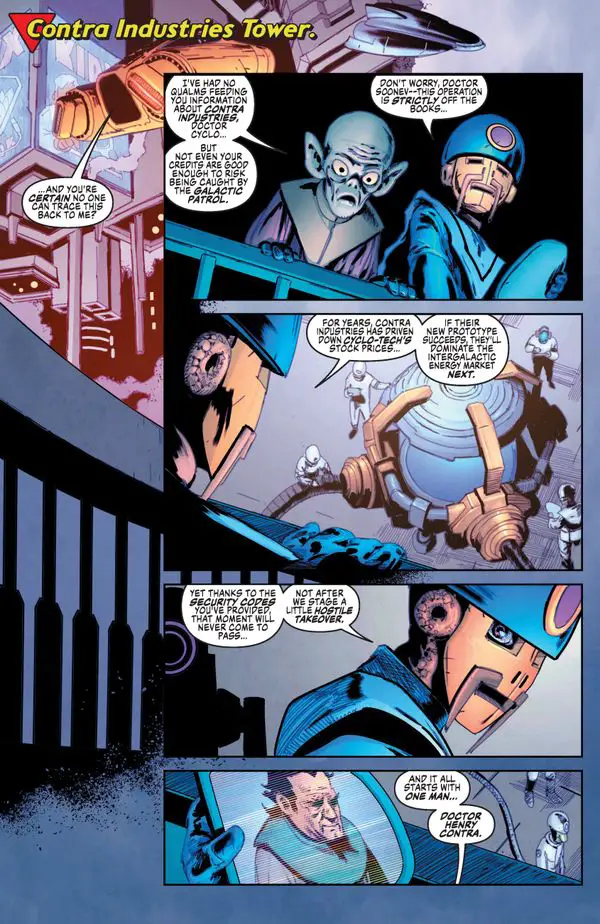
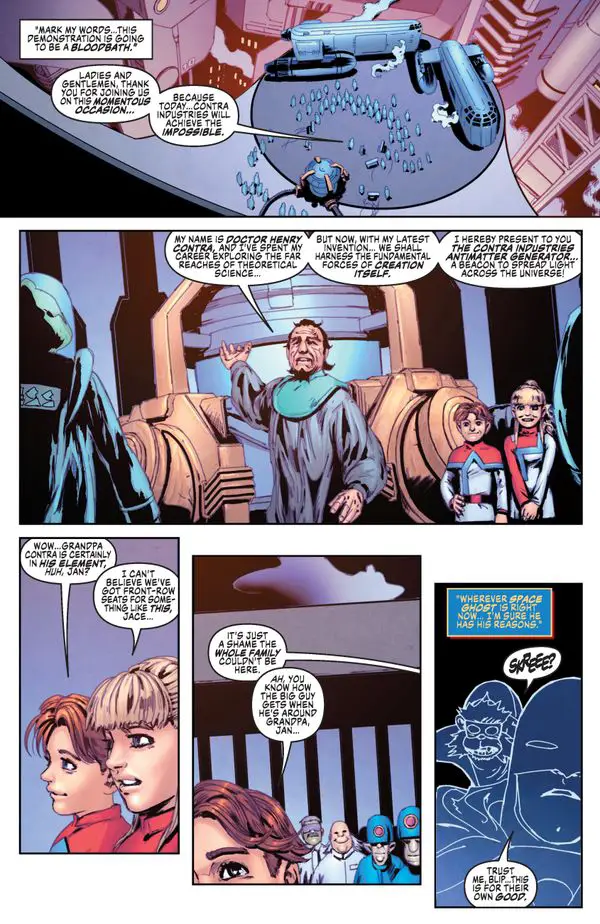
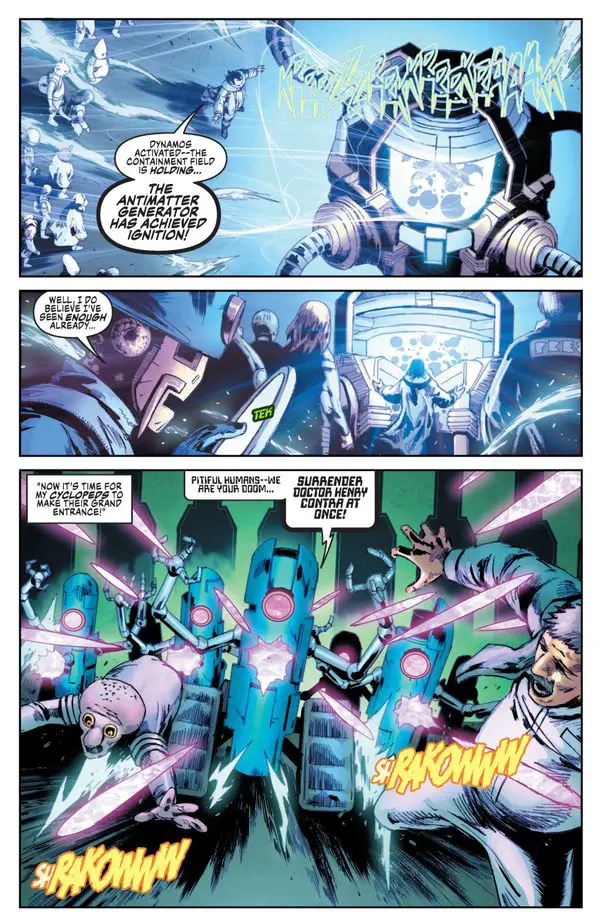
Doctor Henry Contra prepares to debut his Antimatter Generator, a revolutionary device meant to harness the fundamental forces of creation and spread light across the universe. Jan and Jace attend the presentation at Contra Industries Tower, proud to watch their grandfather achieve his scientific masterpiece. Unknown to them, an insider has been feeding security codes to Doctor Cyclo and his agents at Cyclo-Tech, who plan to sabotage the demonstration as part of a hostile corporate takeover. As Contra’s speech about building a better future for his grandchildren reaches its emotional peak, the Cyclopeds launch their attack, destroying the generator and critically injuring the elderly scientist.
Space Ghost arrives too late to prevent the disaster, beating back the robots and rushing Doctor Contra to the hospital where he stabilizes. However, something sinister has occurred during the exposure to uncontrolled antimatter energy. Jan and Jace notice their grandfather has become irritable and hostile in ways they have never witnessed before, barking at them like they have betrayed him. Meanwhile, Space Ghost investigates the attack and tracks the conspiracy back to Doctor Cyclo’s secret lab, discovering the villain dead, burned from the inside-out by traces of antimatter energy. Someone has already killed Cyclo, and the evidence suggests the culprit knew exactly what they were doing.
Doctor Contra returns to Contra Mansion, where he begins to experience something far worse than his physical injuries. The antimatter exposure has created a split in his consciousness, and another entity emerges: a being of pure darkness and rage that calls itself the Antimatter Man. This alter-ego hunts down and kills Doctor Cyclo, revealing itself as the opposite of everything Doctor Contra represents. When Space Ghost confronts the scientist about the threat, the Antimatter Man takes full control, completely overwhelming the hero through sheer force and molecular manipulation. The issue ends with Doctor Contra undergoing a catastrophic radiation cascade at Contra Mansion, while Jan and Jace frantically call for Space Ghost as they realize their grandfather has become something terrifying and dangerous.
Story
David Pepose executes one of the sharpest tonal pivots in the series, moving from corporate intrigue to body-horror transformation without losing narrative momentum. The dialogue crackles with character distinction, from Contra’s grandfatherly warmth during his presentation to the cold corporate speak of the Cyclo-Tech conspirators. The script trusts readers to understand that Contra is not acting like himself after the explosion, dropping hints through his uncharacteristic anger toward his grandchildren rather than explaining it outright.
The pacing accelerates perfectly in the final act, moving from hospital recovery to Cyclo’s murder to the full emergence of the Antimatter Man, creating genuine urgency. The one structural weakness is that the reader does not definitively see Contra creating the Antimatter Man until the very end; the story dances around it in a way that reads as intentionally mysterious but occasionally muddy.
Art
Jonathan Lau continues his high-caliber work, delivering clean panel layouts that distinguish between the polished corporate setting and the gritty chaos of the tower attack. The color palette shifts dramatically between scenes: warm, professional tones for the presentation sequence give way to cold, clinical hospital blues, then finally to dark, violent reds and blacks in the Cyclo-Tech lab. The creature design for the Antimatter Man is genuinely unsettling, rendered as an inverse of light with sharp, jagged composition that makes it feel fundamentally wrong compared to Space Ghost’s clean lines.
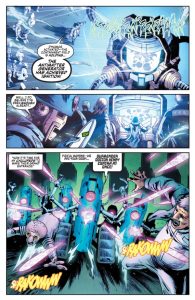
The explosion sequence during the attack is particularly strong, using selective focus and dynamic angles to emphasize the sudden shift from victory to disaster. Dalhouse’s coloring choice to render antimatter effects as voids and shadows rather than bright energy is brilliant and thematically appropriate.
Characters
Doctor Contra presents a fascinating study in character fracturing. His opening speech about building a better future for his grandchildren is genuinely moving and establishes him as a loving, forward-thinking patriarch. The shift to hostility in the hospital scene lands harder because we have just witnessed his warmth and vulnerability.
The Antimatter Man, as presented here, is the dark inverse of Contra’s optimism, a force of pure destruction born from the very moment he tried to create something beautiful. Space Ghost’s investigation and confrontation add layers to his character, showing him not as the invincible hero but as someone grappling with a threat he cannot punch into submission. Jan and Jace function as the emotional anchors, their concern for their grandfather and confusion about his behavior giving the reader a genuine emotional stake in the unfolding disaster.
Originality & Concept Execution
The Antimatter Man concept itself is not entirely original, but Pepose’s execution transforms it into something fresh by making it a literal manifestation of Contra’s fractured psyche rather than an external villain. The idea of an alter-ego created through scientific accident feels like a natural evolution of the series’ science-fiction foundation.
The twist that Contra is not conscious of his other self adds psychological depth that elevates this beyond simple body-horror. The execution succeeds in delivering on the teased threat from the previous issue’s final panel, making good on the promise that stakes would escalate. However, the concept leans heavily on tropes familiar to readers of Jekyll-and-Hyde stories, so the originality lives primarily in the specific context and execution rather than the core premise.
Positives
The real strength here is the character work and tonal execution. Watching Doctor Contra’s descent from loving grandfather to unwitting host of a destructive force is genuinely unsettling, and Pepose nails the emotional beats that make it land. The corporate sabotage subplot serves as an elegant setup, establishing both external conflict and the circumstance that triggers the horror.
Jonathan Lau’s visual storytelling is exceptional, particularly in the hospital scenes where subtle acting choices convey Contra’s internal transformation better than dialogue ever could. The pacing is relentless without feeling rushed, giving each major beat room to breathe before accelerating into chaos. The decision to make the Antimatter Man an unconscious alter-ego rather than a possessed victim is genuinely clever, transforming the premise from standard superhero fare into something psychologically complex.
Negatives
The primary weakness is that the exact mechanism of the Antimatter Man’s creation remains unclear until the very final pages, making the middle section feel slightly unfocused. Readers know something is wrong with Contra, but the comic does not commit fully to revealing the truth until the grand unveiling at Contra Mansion. While this serves the mystery, it occasionally reads as the story withholding information rather than building genuine suspense.
Additionally, the confrontation between Space Ghost and the Antimatter Man, while visually impressive, ends almost as soon as it begins, with the Antimatter Man simply deciding to leave rather than finish the fight. This undermines the threat level somewhat and raises questions about the villain’s motivations that do not get answered. The corporate espionage subplot, while effective as a trigger, feels slightly thin and could have benefited from more development to make the stakes feel heavier at the presentation sequence.
Art Samples:
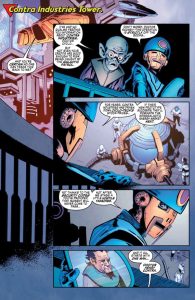
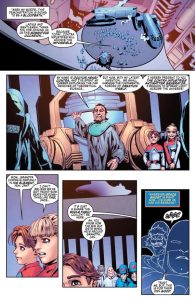
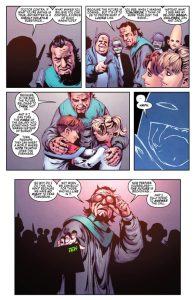
The Scorecard:
Writing Quality (Clarity & Pacing): [3.5/4]
Art Quality (Execution & Synergy): [3.5/4]
Value (Originality & Entertainment): [1.5/2]
Final Thoughts:
(Click this link 👇 to order this comic)
SPACE GHOST (VOL. 2) #7 is a strong, emotionally resonant chapter that successfully pivots the series toward darker, more complex territory. The character work is exceptional, and the visual storytelling ranks among the series’ best. However, the mystery elements occasionally obscure clarity, and the Antimatter Man’s characterization needs more definition to reach the next tier of storytelling. This is the issue where casual readers might fall off if they are not invested in long-form narrative development, but long-time fans will find it rewarding enough to justify the purchase, especially as a setup for what promises to be a devastating arc. It is not perfect, but it is essential reading for anyone following the series.
We hope you found this article interesting. Come back for more reviews, previews, and opinions on comics, and don’t forget to follow us on social media:
If you’re interested in this creator’s works, remember to let your Local Comic Shop know to find more of their work for you. They would appreciate the call, and so would we.
Click here to find your Local Comic Shop: www.ComicShopLocator.com
As an Amazon Associate, we earn revenue from qualifying purchases to help fund this site. Links to Blu-Rays, DVDs, Books, Movies, and more contained in this article are affiliate links. Please consider purchasing if you find something interesting, and thank you for your support.