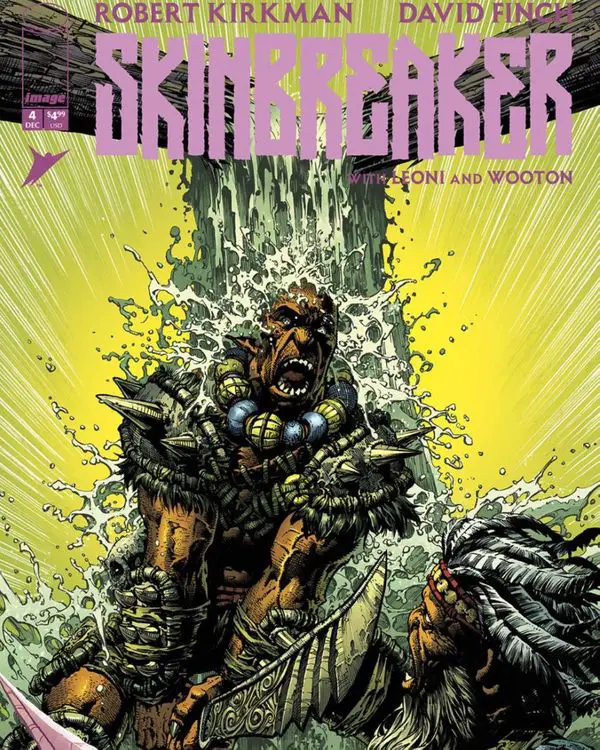
Skinbreaker #4, by Image Comics on 12/24/25, delivers the formal duel that issue #3 promised, and it commits to resolving it in brutal, game-changing fashion.
Credits:
- Writer: Robert Kirkman
- Artist: David Finch
- Colorist: Annalisa Leoni
- Letterer: Rus Wooton
- Cover Artist: David Finch, Annalisa Leoni (cover A)
- Publisher: Image Comics
- Release Date: December 24, 2025
- Comic Rating: Teen
- Cover Price: $4.99
- Page Count: 36
- Format: Single Issue
Covers:
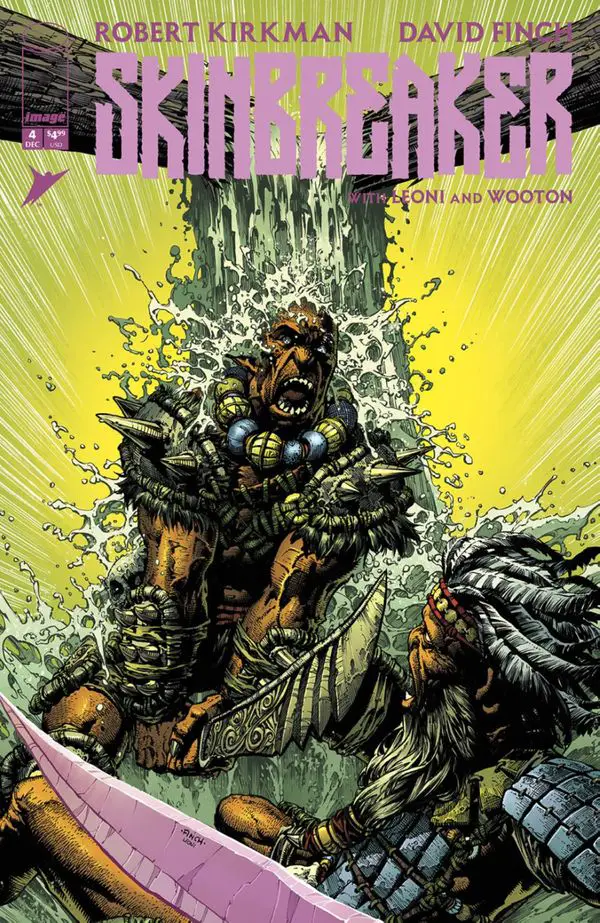
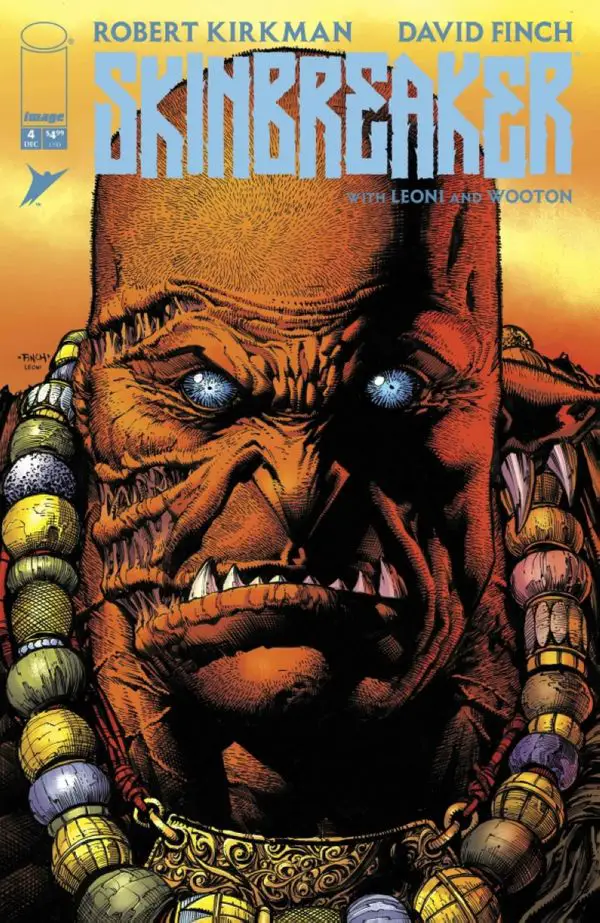
Analysis of SKINBREAKER #4:
First Impressions:
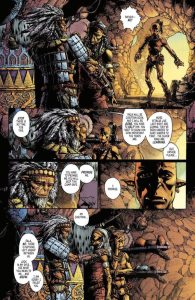
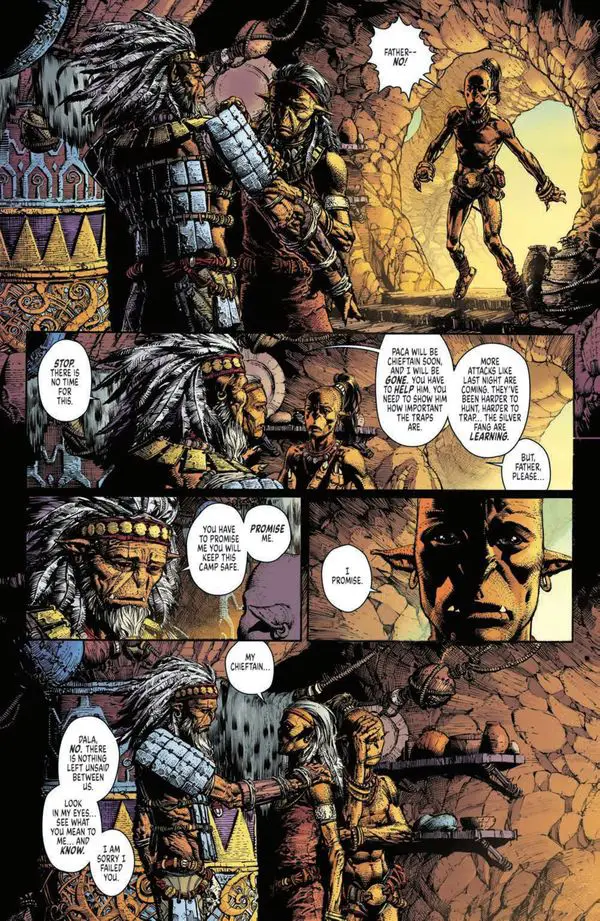
The opening dialogue lands like a punch to the chest: Anok has mere moments to say goodbye to his mate Dala before the duel, and the comic wastes zero time on soft farewells or drawn-out monologues. His instruction to their son about maintaining the traps while Paca becomes chieftain sets the tragedy into motion immediately, and the shift from personal goodbye to larger political collapse feels earned rather than rushed. This is a comic that understands the weight of ritual and the speed of irreversible decisions.
Recap:
Issue #3 ended with Anok standing alone after his unseen victory over one Silver Fang, only to return to the village and find Paca claiming public glory for killing a second beast. Paca mocked Anok’s invisible win, framed the chieftain as weak and out of touch, and then formally challenged him for leadership. Anok protested that the tribe faced immediate danger from evolving predators and had no time for internal conflict, but Paca silenced him and the crowd turned cold. The issue closed with Anok forced to accept the challenge even as he tried to warn his people that larger threats were coming. Now, issue #4 forces that ritual to a conclusion.
Plot Analysis:
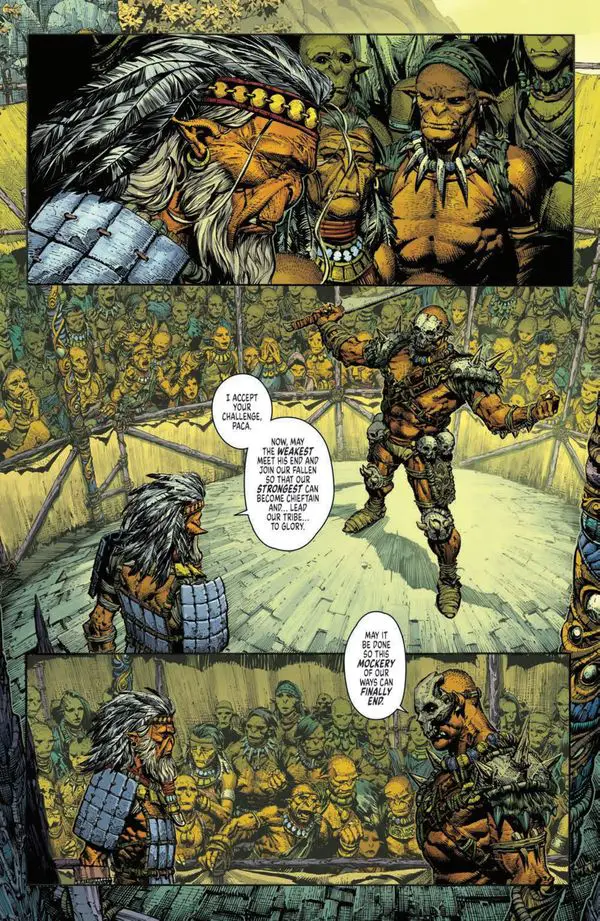
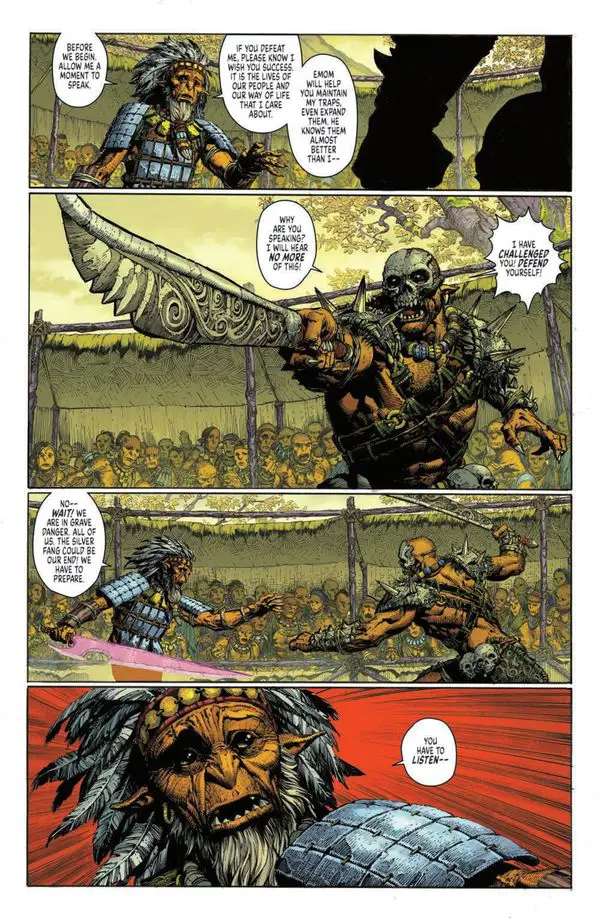
The issue opens with Anok and his mate Dala in a private moment where he tells her to expect his death but not to despair. He instructs her to help Paca understand the importance of the traps and warns that more Silver Fang attacks are coming, knowing he will not be there to defend the tribe. Anok accepts Paca’s challenge formally, and Paca responds with a ritualistic phrase declaring that the weakest must fall. Before combat begins, Anok speaks a final plea for his son to remember the traps and to understand that tools have made their lives better, but Paca cuts him off mid-sentence and refuses to hear more warnings.
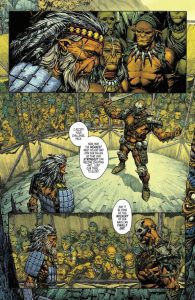
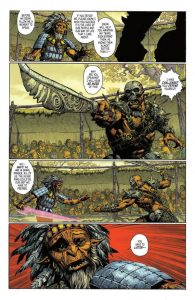
The fight erupts with Anok and Paca clashing violently, with Anok trying to speak reason while Paca attacks with brutal intent. Paca accuses Anok of following the “Sword-Shatterer” ways and spreading weakness, vowing to undo all of Anok’s work and return the tribe to the old ways of strength and honor. The crowd grows impatient and demands blood, shouting at the combatants to finish the spectacle. Paca overpowers Anok and forces him to his knees with a decisive blow, disarming him and leaving him defenseless. Anok makes one final appeal to the tribe, insisting that the old ways will bring certain death, but Paca silences him with another strike and declares himself the new chieftain. In a clever move, Anok rolls out of the assault and flees into the jungle.
As Paca hunts the defeated Anok, the former chieftain sheds his armor and sword, leaving his mantle for Paca to find. Paca leaves breaks off the hunt after recovering the mantle, leaving Anok to die in the jungle in shame. Paca then takes the Skinbreaker, the ritual blade that marks chieftain status, claiming it as his own. The issue ends with Paca victorious and Anok left broken and weaponless in the aftermath, while the new chieftain promises both to restore the tribe to old ways. Meanwhile, Anok treks off into the jungle alone.
Story
Kirkman’s script is relentless, cutting scene to scene with razor focus to create inevitability rather than suspense. There is no filler or breath; the opening goodbye with Dala takes only panels before the fight dominates the issue, and this forward momentum serves the climax well. Dialogue is sparse and ritualistic, which fits the duel’s formal nature but also prevents Paca’s ideological objections from landing with full weight. Anok’s warnings about Silver Fang attacks are cut off and dismissed, which mirrors the communication breakdown thematically but leaves his argument underdeveloped. The structure itself is tight and efficient: goodbye, challenge, fight, defeat, ascension, and promise of future conflict. However, the issue retreads ground from #3 without significantly advancing the core tension; readers get little new insight into why Paca sees innovation as corruption beyond vague accusations of weakness.
Art
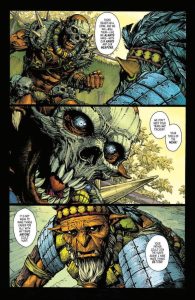
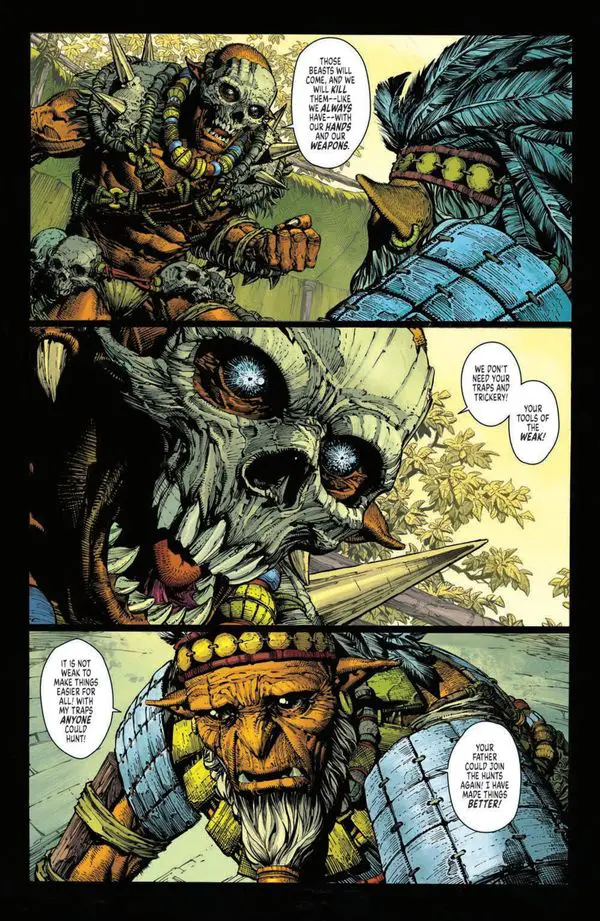
David Finch’s rendering of the duel is exceptional, with heavy blacks and dynamic postures making every exchange crystal clear and weighted with consequence. The kinetic energy of the fight is easy to follow across panel sequences, and the contrast between Anok’s aging body and Paca’s youthful strength is communicated purely through line and form, allowing the art to carry narrative weight where dialogue could have faltered. The composition of Anok on his knees, disarmed and defeated, uses negative space and low angles to emphasize his fall from authority, while Paca standing over him with the Skinbreaker is framed as a clear moment of political ascension.
Annalisa Leoni’s color work shifts from warm earth tones in the opening goodbye to darker, more ominous hues as the fight escalates, creating a visual arc that reinforces the narrative turn. One minor limitation is that the tight panel focus on the fighters themselves removes some of the environmental context that Finch builds so skillfully elsewhere in the series.
Characters
Anok remains consistent with his established arc as an aging leader unable to defend his vision through force, and his insistence on warning the tribe about danger even while losing shows principle rooted in genuine concern rather than ego. However, the issue provides no new dimension to his character; he is exactly where issue #3 left him, grappling with the same doubts and priorities. Paca emerges as a pure antagonist driven by wounded pride and ideological rigidity, with his refusal to hear Anok’s warnings matching his behavior from the previous issue. His characterization is believable but remains abstract; readers never understand what specific Anok policy troubles him most or why the old ways matter beyond vague appeals to honor and strength. The crowd functions as a semi-character reflecting the tribe’s hunger for spectacle over substance, reinforcing the theme that ideas lose to entertainment in public opinion.
Originality & Concept Execution
The leadership duel decided by force rather than merit is not a new concept, but Kirkman and Finch execute it with thematic precision that tightens the series’ core tension. The duel is not framed as a test of worthiness or divine will; it is simply ritual combat where the strongest wins, which is precisely why Anok, with better ideas and worse knees, has no chance. This execution clarifies the story’s central tragedy: good ideas do not win if no one will listen, and force remains the ultimate arbiter in a world built on physical strength. The commitment to letting Paca win cleanly rather than deploying a surprise reversal gives the moment real weight and consequence.
Positives
The best use of the reader’s dollar is in the visual clarity and emotional punch of the duel itself. Finch’s panel composition during the fight is a masterclass in legibility and consequence, making every exchange easy to follow and heavy with meaning. The contrast between Anok’s aging physicality and Paca’s youthful aggression is communicated through form alone, transforming the art into pure storytelling without reliance on exposition.
The decision to strip dialogue down to minimal, ritualistic exchanges creates an almost silent-film quality that forces readers to track meaning through expression, posture, and crowd reaction rather than narration. This is visual narrative at a high level, and it pays measurable dividends in making the climax feel inevitable and earned. Additionally, the opening scenes with Dala deliver genuine emotional weight in just a few panels; Anok’s certainty that he will not survive, paired with his focus on practical instructions rather than sentiment, conveys both his character economy and his priorities with precision.
Negatives
The greatest drawback is that the issue amounts to execution of setup established in #3 rather than new story development. Readers already know Paca challenged for leadership, so this duel is climax without expansion, which can feel thin on its own. The Silver Fang threat feels underdeveloped; Anok mentions future attacks but does not elaborate, and Paca dismisses them entirely without the comic pausing to emphasize just how catastrophic the danger might be. As a result, the reader never feels the full weight of the tribe’s peril, which undercuts the tragedy of losing a leader who saw danger coming.
Additionally, the brevity that keeps pacing sharp also means the ideological clash between old and new ways is stated but never truly debated, leaving the conflict feeling more like personal ambition than genuine philosophical opposition. Finally, the issue offers little setup or foreshadowing for what comes next, leaving readers without a clear sense of where the series pivots after this climax, which risks feeling incomplete if issue #5 takes time to establish new stakes.
Art Samples:
The Scorecard:
Writing Quality (Clarity & Pacing): [3/4]
Art Quality (Execution & Synergy): [4/4]
Value (Originality & Entertainment): [2/2]
Final Thoughts:
(Click this link 👇 to order this comic)
SKINBREAKER #4 is a visually stunning, narratively direct execution of a foregone conclusion, and it never apologizes for that. The duel is rendered with exceptional clarity and kinetic energy, and the commitment to not letting Paca win cleanly rather than pulling a surprise reversal gives the issue real weight and consequence. However, the story itself does not significantly advance the series beyond confirming what issue #3 promised, and the ideological clash at the heart of the conflict is stated rather than truly explored.
We hope you found this article interesting. Come back for more reviews, previews, and opinions on comics, and don’t forget to follow us on social media:
If you’re interested in this creator’s works, remember to let your Local Comic Shop know to find more of their work for you. They would appreciate the call, and so would we.
Click here to find your Local Comic Shop: www.ComicShopLocator.com
As an Amazon Associate, we earn revenue from qualifying purchases to help fund this site. Links to Blu-Rays, DVDs, Books, Movies, and more contained in this article are affiliate links. Please consider purchasing if you find something interesting, and thank you for your support.