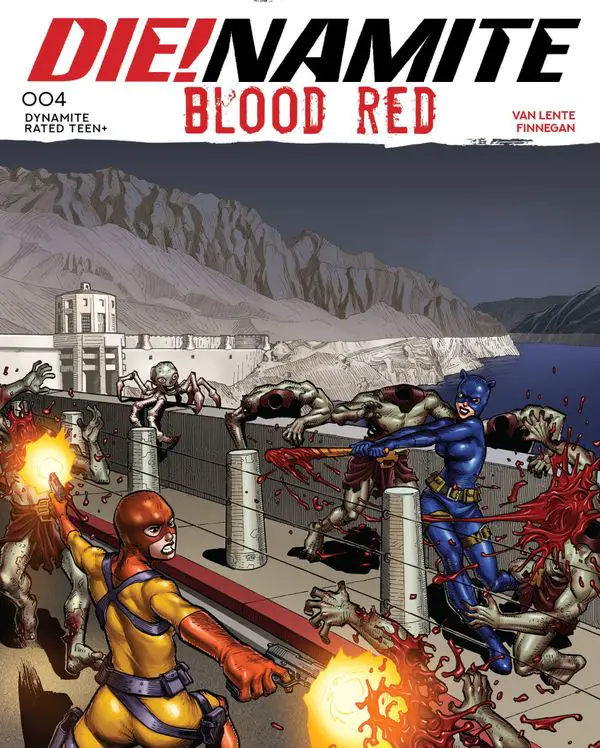
DIE!namite: Blood Red #4, by Dynamite Comics on 1/14/26, throws the team directly into the villain’s lair with a mystery box that explodes into a decades-old grudge wrapped in planetary genocide.
Credits:
- Writer: Fred Van Lente
- Artist: Marco Finnegan, Emanuele Ercolani, Jordi Perez
- Colorist: Ellie Wright
- Letterer: Jeff Eckleberry
- Cover Artist: E.J. Su (cover A)
- Publisher: Dynamite Comics
- Release Date: January 14, 2026
- Comic Rating: Teen+
- Cover Price: $4.99
- Page Count: 22
- Format: Single Issue
Covers:
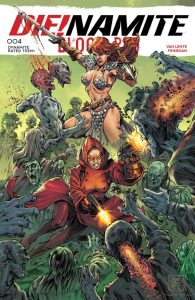
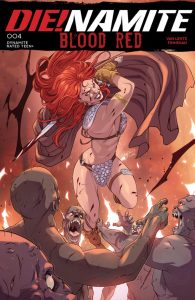
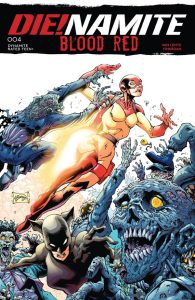
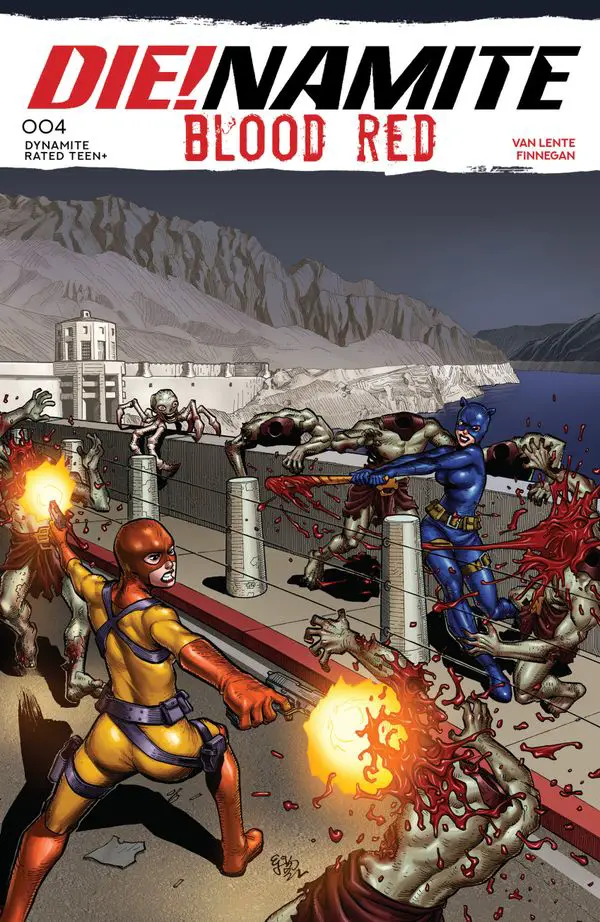
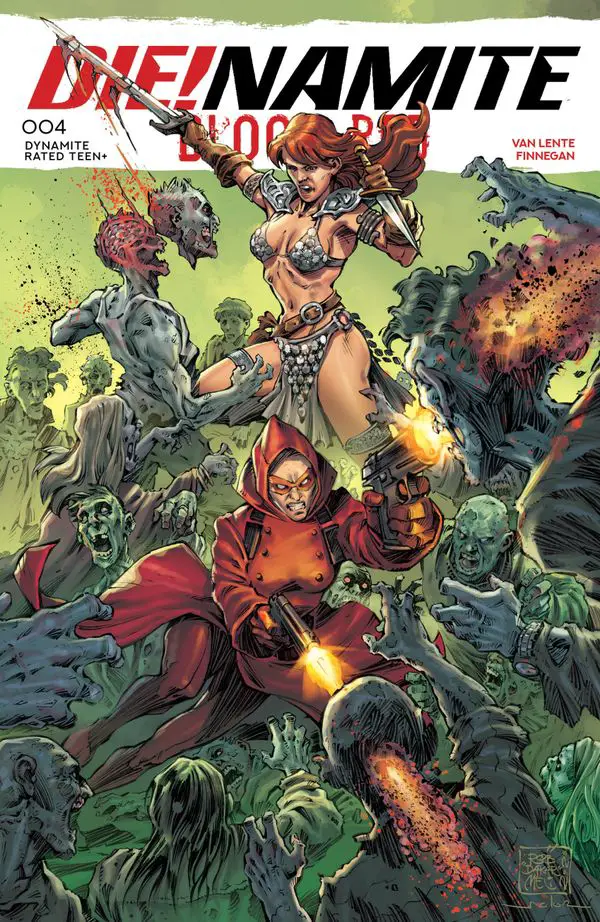
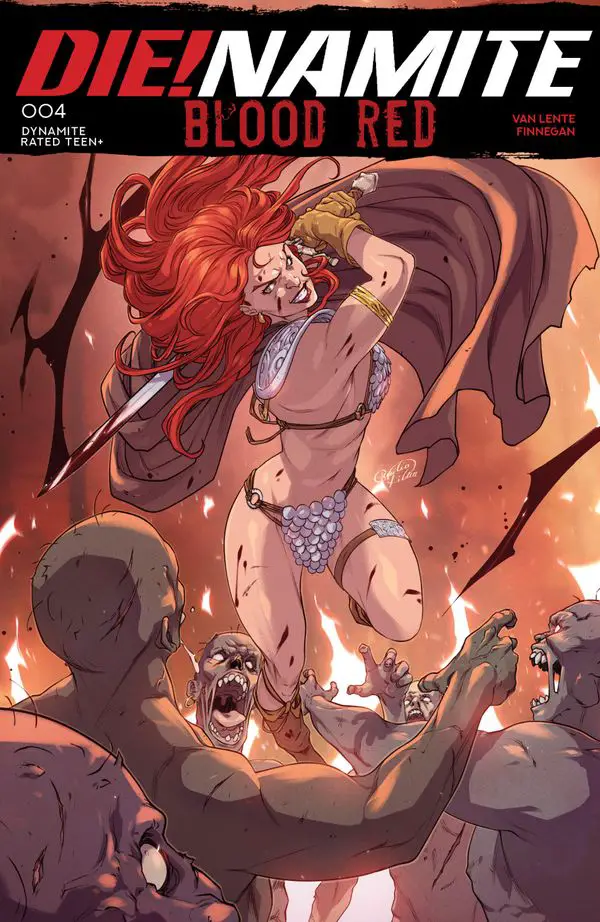
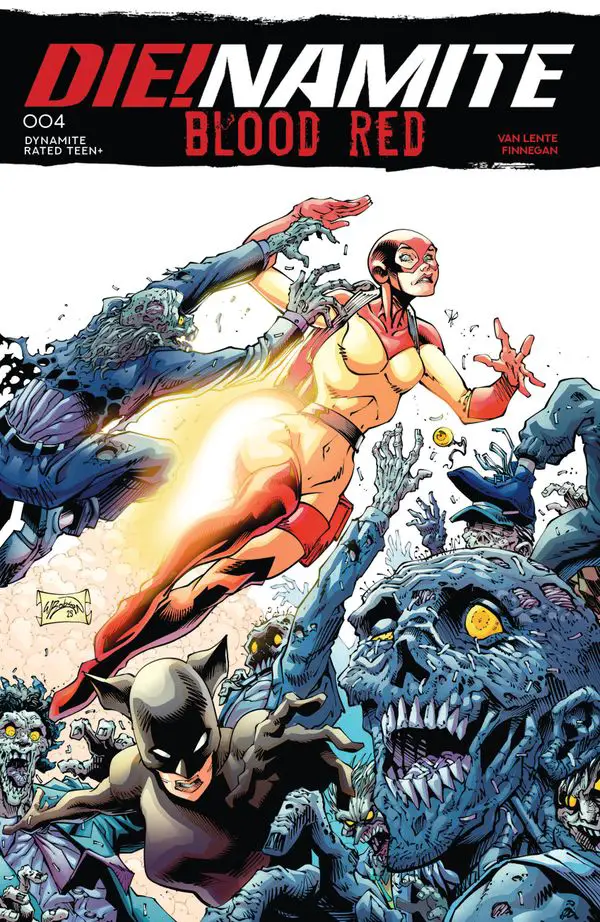
Analysis of DIE!NAMITE: BLOOD RED #4:
First Impressions:
The opening page hits hard with dark humor and immediate tension as the crew discovers Stannis is actually bait for a trap. The premise of walking into the stronghold of the scientist who created the plague that decimated Earth feels like it should have weight, but the pacing rushes through character stakes so quickly that emotional investment never takes hold. The visceral horror of Taak’s plan to build an even worse virus undercuts everything with a logical problem the script never addresses.
Recap:
In DIE!namite: Blood Red #3, the team navigated underground sewers from Las Vegas toward Hoover Dam while Vampirella struggled to control her bloodlust. Dejah Thoris offered her Martian blood as sustenance, and they discovered Stannis’s corpse in the water, suggesting the sewer route wasn’t as safe as promised. Fury remained skeptical about the entire operation while Sonja provided local knowledge and combat support. The group was closing in on Taak’s position with mounting tension about Vampirella’s reliability as a team member.
Plot Analysis (SPOILERS):
The issue opens with the crew confronting Taak in his makeshift fortress, where he’s been breeding Rykors, headless bio-servants he controls psychically. Vampirella is captured immediately and experiences some kind of mental degradation from feeding on Dejah’s Martian blood earlier. In a brief flashback, Purgatori contacts Fury with a secret mission: eliminate Vampirella if she becomes a problem, creating a hidden conflict within the team structure. The revelation that Taak isn’t actually human shocks no one but confirms his intelligence and danger level.
Taak’s backstory unfolds through exposition: Dejah Thoris and her father asked him to engineer a gender-specific plague to use against their enemy Zodanga on Mars. The virus escaped containment and devastated all of Mars, so Taak fled to Earth using astral projection, accidentally bringing the plague with him. Now he’s weaponizing it further, developing a virus that affects women as well as men to destroy Dejah Thoris and everyone she cares about. The plot reveals that Dejah came to assassinate him, not cure anyone, raising questions about whose story is actually true.
Combat erupts as Taak’s Rykors attack and Vampirella screams offscreen. Sonja hacks at headless enemies while Fury recognizes they’re outmatched, and the team questions whether saving Vampirella is worth dying for. Taak demonstrates his mental connection to his servants, controlling multiple bodies simultaneously and predicting the team’s movements. The issue ends with Taak preparing to either enslave Fury or kill her, leaving Vampirella’s fate uncertain and the cure mission effectively abandoned in favor of survival.
Story
Van Lente delivers standout comedic moments; the joke about Stannis’s weight mixed with casual cannibalism works perfectly, and the “armpit blood” line from Vampirella lands with exactly the right timing. Character banter between Fury and Dejah maintains strong contrast without feeling repetitive. However, the structure has a fundamental problem: the issue front-loads a massive exposition dump about Taak’s history on Mars that kills momentum right when action should escalate.
The backstory isn’t organic to the conversation; it’s dumped as a monologue that goes on for multiple pages, treating readers like they’re taking notes for a test rather than experiencing a story. The subplot about Purgatori ordering Fury to kill Vampirella is introduced, developed, and then ignored for the rest of the issue, leaving the tension unresolved and making that entire section feel like setup for a future issue rather than part of this one’s narrative. Dialogue remains sharp, but structure undermines its impact.
Art
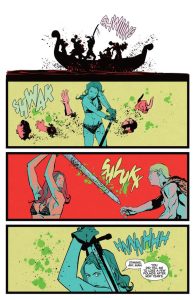
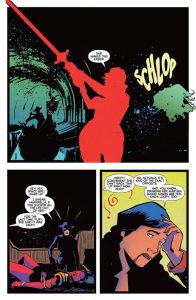
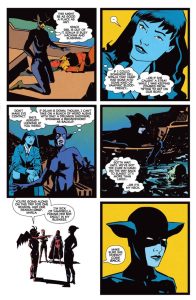
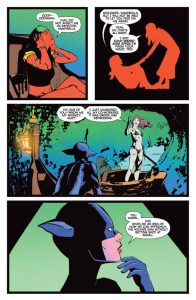
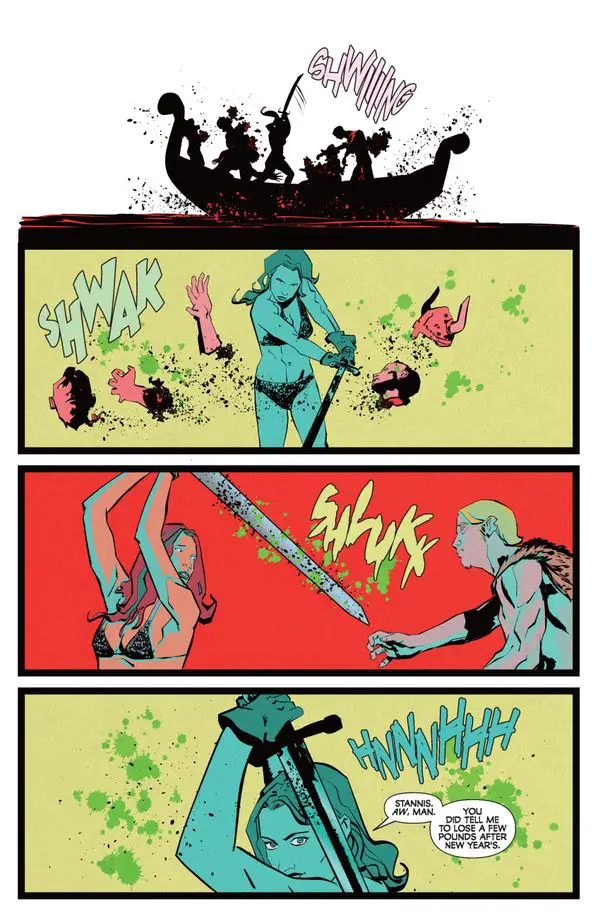
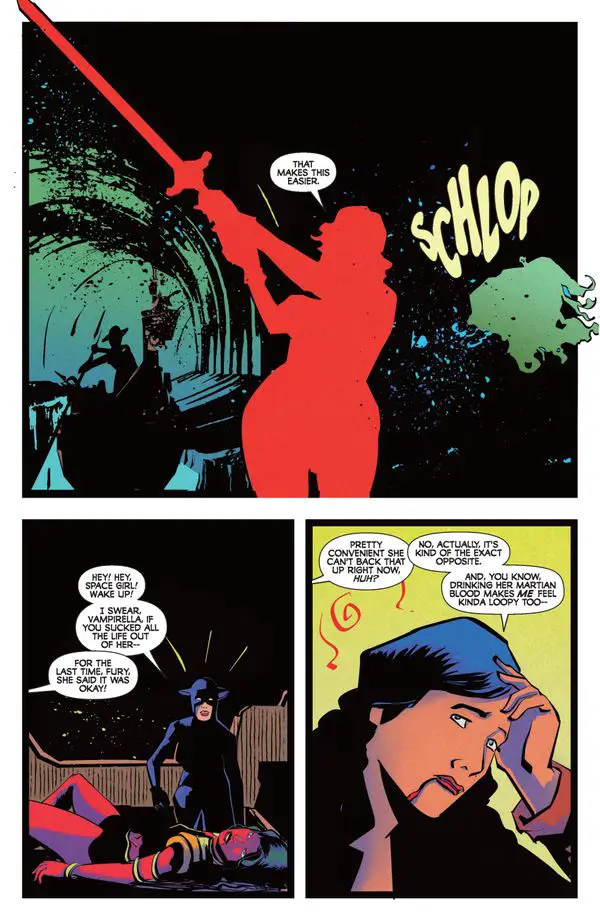
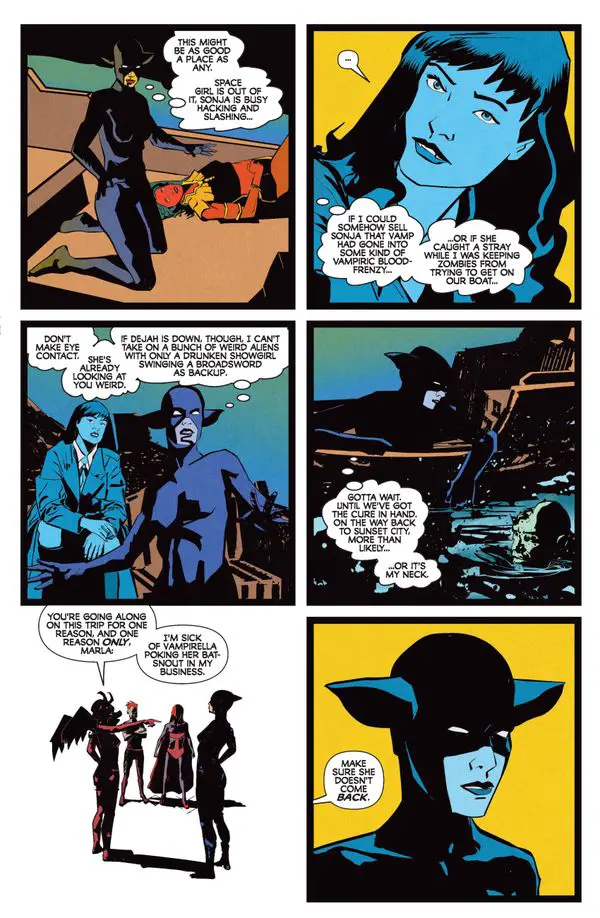
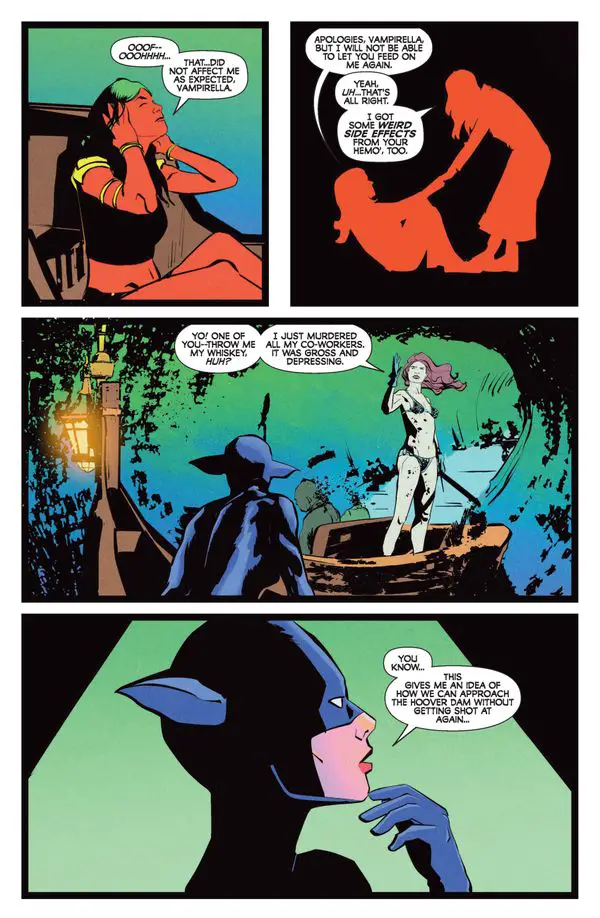
The artwork credited to three artists (Finnegan, Ercolani, Perez) shows inconsistent hand throughout the issue. The opening pages with Stannis are clear and readable, establishing space effectively. However, once Taak’s exposition sequence begins, the art becomes a muddy assemblage of speech bubbles and unclear panel transitions that prioritize dialogue over visual storytelling. The Rykors themselves are rendered confusingly; it’s initially unclear whether they’re aliens, zombies, or something else entirely, and the design doesn’t scream “bioengineered servant” so much as “generic headless monster.”
The combat sequence in the final pages feels scattered across the panel grid without a clear sense of spatial relationships or positioning. Color work doesn’t establish mood effectively; the entire sequence feels flat and gray, missing opportunities to distinguish Taak’s lair as a distinctive location. The final image of Taak’s disembodied head is meant to be grotesque, but it’s rendered so plainly that it reads as a medical diagram rather than horror.
Characters
Dejah Thoris is revealed to potentially be a war criminal using the team to assassinate her former employee, but the script treats this revelation as a single sentence rather than a seismic shift. Her prior characterization as a determined, direct leader doesn’t align with this deception, and the issue doesn’t explore the contradiction. Vampirella’s capture and mental deterioration from Martian blood happens offscreen in a single scream, removing any chance for readers to experience her agency or resilience.
Fury’s secret order to kill Vampirella is interesting character work that suggests internal conflict, but it’s introduced and abandoned before any character development emerges. Sonja continues to be a cardboard cut-out swinging a sword without personality or reason to matter beyond “local guide with a weapon.” Taak gets a sympathy angle as a scientist who was coerced and then framed by the Helium ruling class, but he immediately undermines it by revealing he’s now trying to commit genocide. The exposition doesn’t make him complex; it just makes him talkative.
Originality & Concept Execution
The core premise of “all-female team fights to survive a plague-apocalypse” promised a fresh take on survival narratives by centering women’s agency and removing the typical male-hero template. This issue completely abandons that framing by introducing a male scientist villain with an elaborate backstory that dominates the narrative. The original premise was also about finding a cure; this issue reveals there is no cure mission, just assassination, which fundamentally retcons the entire series’s purpose. That’s not a twist; that’s a bait-and-switch.
The idea of a headless bioservent army is visually distinct but narratively underdeveloped. The Rykors could be interesting enemies if their design or tactics suggested something beyond “zombie stand-ins,” but they’re functionally identical to the Deadmen the team already fought underground, removing any sense of escalation. The issue trades the series’ established concept for planet-hopping sci-fi exposition that feels borrowed from 1950s pulp magazines without adding anything fresh.
Positives
Van Lente’s dialogue remains consistently sharp, with character voices distinct enough that readers track who’s speaking without needing a name tag. The humor moments land hard and provide levity without undermining the stakes. The revelation that Purgatori secretly ordered Vampirella’s assassination is strong character work suggesting political games within the survivor camp. Taak’s backstory, while convoluted, does provide world-building explanation for why the plague exists and spreads, giving readers context even if the delivery is clumsy. The action sequences have clear impact and momentum, preventing any scene from feeling static.
Negatives
The exposition dump about Taak’s history takes up nearly half the issue and kills pacing by switching from action to monologue just when momentum matters most. The art becomes muddy and unclear during key scenes, requiring readers to work harder to parse visual information during climactic moments. Vampirella’s capture and mental breakdown happen entirely offscreen, removing reader investment in her peril. The series’ premise about finding a cure is retroactively revealed as a lie, which feels like a betrayal of reader investment rather than a clever twist. The Rykors aren’t visually or narratively distinct from previous enemies, making the escalation feel redundant. Sonja remains a personality-free plot device, and Dejah’s potential moral compromises aren’t explored beyond a single revelation.
Art Samples:
The Scorecard:
Writing Quality (Clarity & Pacing): [2/4]
Art Quality (Execution & Synergy): [1.5/4]
Value (Originality & Entertainment): [0.5/2]
Final Thoughts:
(Click this link 👇 to order this comic)
DIE!NAMITE: BLOOD RED #4 s a narrative catastrophe disguised as an action issue. The script pulls the rug out from under three issues of premise-building by revealing the team was sent on a murder mission rather than a cure mission, then wastes half its pages on a villain monologue that reads like the writer discovered Wikipedia and wanted to share everything he learned. The art can’t keep pace with the action, the team’s internal conflict gets introduced and abandoned, and Vampirella’s entire presence in the issue consists of a single screaming sound effect. Your time and money would be better invested in almost anything else on the shelf.
We hope you found this article interesting. Come back for more reviews, previews, and opinions on comics, and don’t forget to follow us on social media:
If you’re interested in this creator’s works, remember to let your Local Comic Shop know to find more of their work for you. They would appreciate the call, and so would we.
Click here to find your Local Comic Shop: www.ComicShopLocator.com
As an Amazon Associate, we earn revenue from qualifying purchases to help fund this site. Links to Blu-Rays, DVDs, Books, Movies, and more contained in this article are affiliate links. Please consider purchasing if you find something interesting, and thank you for your support.