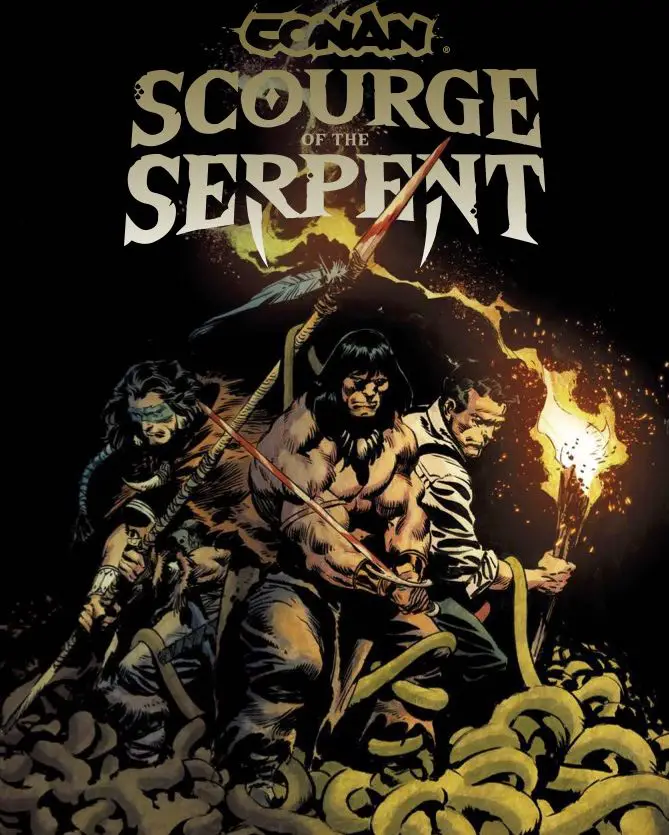
Conan: Scourge of the Serpent #4, by Titan Comics on 1/7/26, finally pulls the trigger on what three heroes actually do when a god offers them everything they want, only to find out that accepting means accepting oblivion.
Credits:
- Writer: Jim Zub
- Artist: Ivan Gil
- Colorist: Jao Canola
- Letterer: Richard Starkings, Tyler Smith
- Cover Artist: Roberto De La Torre (cover A)
- Publisher: Titan Comics
- Release Date: January 7, 2026
- Comic Rating: Mature (gore, nudity)
- Cover Price: $4.99
- Page Count: 32
- Format: Single Issue
Covers:
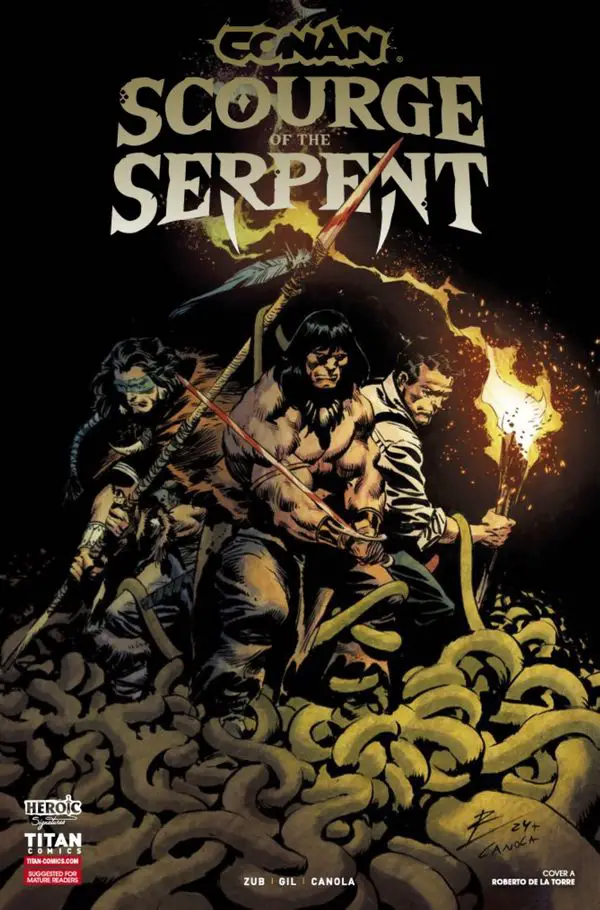
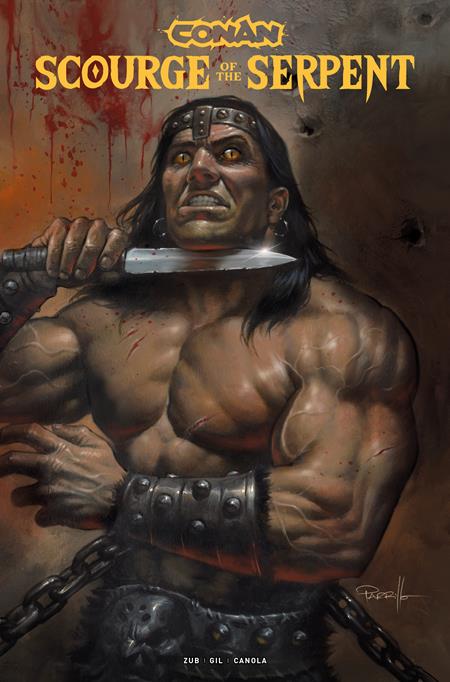
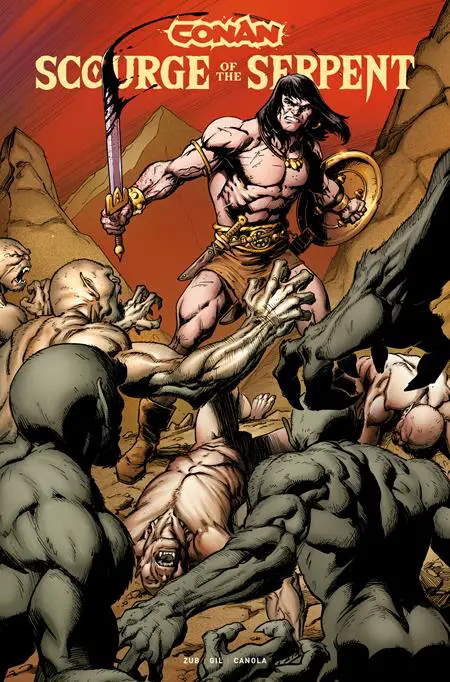
Analysis of CONAN: SCOURGE OF THE SERPENT #4:
First Impressions:
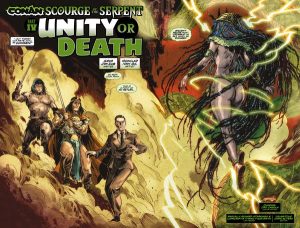
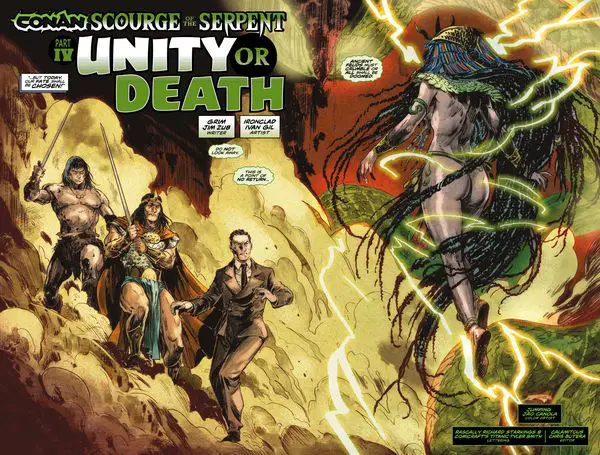
The opening pages hit hard and weird in equal measure. Three warriors from three different times suddenly stand face to face with Set, a cosmic entity that talks like a poet and looks like the worst nightmare a fever could construct. The moment feels genuinely unsettling because it breaks every rule the story has been following: no more separate scenes, no more timeline jumping, just three guys talking to a god while existence bends around them. The hook lands instantly, but so does the question of whether the issue will spend more time showing the conversation than showing what comes after.
Recap:
Previously, In Boston, Kirowan and O’Donnell uncovered that the serpent ring was not just a cursed object but a conduit for Yosef Vrolok, an ancient occultist who had been Kirowan’s rival across multiple lifetimes. Vrolok had possessed Evelyn Gordon and turned her into a weapon, making her attack her own husband and those trying to help. In Numalia, Conan fought a god-thing loosed from a Stygian bowl, an impossible creature that nearly killed him before his refusal to yield gave him the strength to land a harder counterattack. In Valusia, King Kull revealed serpent-men in his own council chamber by speaking a magic phrase, unmasking traitors who had hidden behind human faces. All three men were left standing in the wreckage of different struggles, but all against the same enemy working across the ages through Set’s cult. The story ended by hinting that something bigger was coming, a cosmic power that made even gods look small.
Plot Analysis:
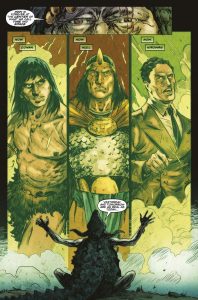
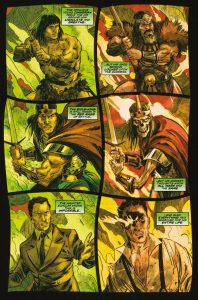
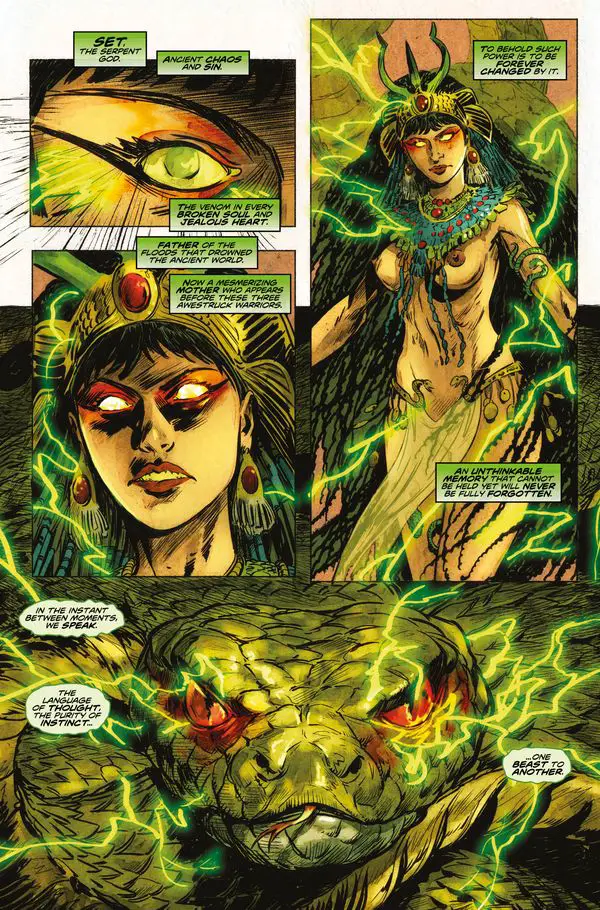
Set materializes before all three men in a moment that exists outside of normal time and space, speaking through thought itself rather than sound, the way cosmic entities probably do when they want to sound genuinely terrifying. The god explains that reality has become unmoored because of an ancient entity called the Woeful Eye that has been asleep since before memory and is now waking up, and that when it arrives, every soul living or yet to come will be devoured unless someone takes action. Set offers a bargain: merge your strength with mine, form a hybrid race that is strong enough to survive this cosmic war, and together we will fight back against the darkness. Set tempts each man personally: Kull is offered eternal kingship and the power to expand Valusia into order and glory, Conan is offered immortality and worship from countless generations, Kirowan is offered complete knowledge of all hidden secrets and the end to his cycle of reincarnation.
For a moment, each man feels the weight of that temptation because Set is offering not just power but resolution, the end to their struggles and the beginning of something greater than themselves. But something deeper in each man, something that refuses to be bought or bent or merged with a god, breaks through the offer like a fist through ice. Their refusal to accept, their stubborn pride, their insistence on remaining themselves even when remaining themselves means staying mortal and limited, that strength becomes the very thing that lets them shake off the temptation and fight back. As they reject Set’s offer, the cosmic presence around them shatters, and each man returns to his own time and place, freed but forever changed by knowing what almost happened.
Kull survives to purge his kingdom of any remaining serpent corruption, determined to rebuild trust through action and bloodshed if necessary. Conan decides that Numalia is a cursed place and leaves to find somewhere his restless soul can actually breathe, moving on as he always does. Kirowan returns to Boston, locks the serpent ring away where no one else can be tempted, and tells O’Donnell that what they faced was real and worse things are probably coming, but at least they know what to watch for now. The final pages hint at something else entirely: a child born of a Cimmerian and a Pict, protected beyond the reach of the cosmic threat, and Set reflecting that perhaps humans, for all their flaws, just might have something worth preserving after all.
Story
The core of the issue works because Jim Zub clearly understands that the climax is not about action but about choice. The script spends significant time on Set’s exposition about the Woeful Eye, the cosmic cycles, and why these three men matter, which could have been tedious but instead works because each explanation lands like a weight on the reader’s chest. The conversation between Set and the heroes uses broken paragraphs, fragmented thoughts, and visual emphasis through lettering to simulate how a cosmic entity would actually communicate versus how a mortal brain would try to understand it.
The dialogue for each man’s temptation is tailored perfectly: Kull gets offered empire, Conan gets offered legend, Kirowan gets offered understanding. That is precise character work. The pacing stumbles slightly after the rejection because the issue tries to show three separate epilogues for each hero in the same number of pages it took to build the main climax, so Conan’s departure and Kirowan’s conversation feel a bit rushed compared to the weight of Set’s presence. The structure is sound overall, but the back half runs on fumes.
Art
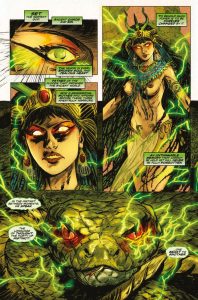
Ivan Gil’s artwork on this issue is the strongest yet because he has to illustrate something that should not be illustrable: a god existing outside of time speaking directly to a human consciousness. He solves this by using radiance and form-shifting; Set appears beautiful and monstrous at once, with features that refuse to stay still on the page, making the reader feel the cosmic wrongness without needing captions to explain it. The composition of panels shows the three heroes standing before Set with careful framing that makes them look small without making them look weak, which is exactly the right balance.
The use of negative space and the way Canola colors the cosmic space around the conversation in mauves and deep purples with hints of gold creates an atmosphere that feels genuinely alien. When the issue shifts back to individual timelines, the colors snap back into their established palettes immediately, which makes the return to reality feel like a slap after the cosmic sequence. Jão Canola’s coloring work keeps each timeline visually distinct even when characters are standing in similar positions, which helps readers track who is where. The only weakness is that the final pages, the epilogue with the hint of a child and Set’s reflection, rush through composition choices that deserve more visual weight.
Characters
Kull’s refusal of eternal empire is perfectly in character because he learned in earlier issues that power without trust is just a crown on a corpse. He does not turn down Set out of humility but out of pride; he wants his empire to be his, earned through his will, not handed over by a god. Conan’s refusal of immortality and legend is equally clean because Conan has always run from anything that tries to define him, even good things. Immortality would trap him, make him a monument instead of a man, and the whole series has been about him moving from place to place because staying still suffocates him.
Kirowan’s refusal of complete knowledge is the deepest moment because he has spent this entire series searching for answers, and the audience could absolutely believe he would take the deal; instead, he rejects it because he realizes that some questions are worth carrying, and that the search itself, the act of seeking, is what keeps him human. All three men remain entirely themselves while also being genuinely tempted, which makes their rejection have weight. The consistency holds across four issues, and the relatability works because each man is saying no to something different, so readers can see themselves in at least one of these choices.
Originality & Concept Execution
The core premise of Scourge of the Serpent has always been that three men from three times are being hunted by the same force, and that force is not really evil but is trying to solve a problem on a cosmic scale by any means necessary. This issue executes that premise by showing that Set is actually not lying: the Woeful Eye is real, the cosmic war is coming, and Set is offering a legitimate solution that would work if anyone accepted it. That is genuinely fresh because most stories make the temptation false or the god a liar, but this issue respects the audience enough to say no, the offer is real, the god is honest, but taking it would still be wrong because it would require sacrificing the thing that makes you yourself.
The execution lands solidly because the rejection does not come from the heroes being heroic or noble but from something harder and stranger: they cannot be merged with a god because they are too stubborn, too rooted in their own particularity, too individual. That is a more interesting reason to reject godhood than “but my friends need me” or “I must protect the innocent.” The concept delivers exactly what it promises.
Positives
The moment where all three men stand before Set and feel the full weight of cosmic presence is masterwork stuff from both writer and artist working in sync. The temptation sequence respects each character’s inner drives while raising stakes that feel genuinely cosmic; this is not a sword fight in a treasure room, this is a negotiation for the future of existence. Zub’s choice to make Set not evil but instead pragmatic, offering honest power in exchange for honest service, makes the refusal mean something, because the heroes are not choosing good over evil but choosing limitation over transcendence.
Gil’s visual rendering of the cosmic space, the weird beauty of Set’s form, and the way he stages three mortal men as actual focal points in a scene that should dwarf them sells the moment completely. The script also earns the epilogue hinting at a child born beyond the reach of the cosmic threat, because that closing image suggests the fight is not over but at least human will and choice still matter. Together, these elements create a climax that does not feel like action movie climax, it feels like a moral philosophy made visible, and that is rare in superhero comics.
Negatives
The biggest cost on value is that this is fundamentally the second half of a story, and readers paying full price get resolution to a problem that spent three issues building but not a satisfying full meal in one chapter. The issue relies on a lot of caption-driven exposition to explain the Woeful Eye, cosmic cycles, and Set’s actual motivations, and while the writing handles it competently, it is still exposition dump dressed up in pretty language; younger readers or anyone who prefers plot-driven stories may find the middle of the issue drags.
The epilogues for each hero feel cut short, especially Conan’s departure from Numalia, which could have used another page of breathing room to let the reader feel his choice to leave the way they felt his choice to stay and fight the god-thing in the museum. Set is framed as temptation made flesh, but the issue assumes readers understand the cosmic mythology and stakes well enough to care about the Woeful Eye without truly earning that care through visual or narrative spectacle; it tells rather than shows how dangerous the threat is. For readers coming in on issue four without reading the first three, this will feel like walking into a conversation that started before they arrived, and the thematic weight will miss its target.
Art Samples:


The Scorecard:
Writing Quality (Clarity and Pacing): [3/4]
Art Quality (Execution and Synergy): [3.5/4]
Value (Originality and Entertainment): [1,5/2]
Final Thoughts:
(Click this link 👇 to order this comic)
CONAN: SCOURGE OF THE SERPENT #4 is a confident, ambitious final chapter that makes a genuine philosophical statement about why immortality is sometimes a trap and why remaining yourself matters more than becoming something greater. It executes its central concept with precision and treats both gods and mortals as forces to be reckoned with rather than heroes and villains in a costume fight. But it also reads like the back half of a bigger story, and if you are counting your pennies and expecting each issue to stand alone, this one asks for commitment to a four-issue event that pays off on its promise but does not hand you a complete meal on the plate.
We hope you found this article interesting. Come back for more reviews, previews, and opinions on comics, and don’t forget to follow us on social media:
If you’re interested in this creator’s works, remember to let your Local Comic Shop know to find more of their work for you. They would appreciate the call, and so would we.
Click here to find your Local Comic Shop: www.ComicShopLocator.com
As an Amazon Associate, we earn revenue from qualifying purchases to help fund this site. Links to Blu-Rays, DVDs, Books, Movies, and more contained in this article are affiliate links. Please consider purchasing if you find something interesting, and thank you for your support.